Many future homebuyers start the process of looking for a house first, and then try to apply for a housing loan, only to be surprised when the approved loan amount from the bank is much lower than the price of their dream home. A smarter approach is to check your actual financial capacity first before even starting to look at properties, so that you search within a realistic price range from the beginning.
Calculate Your Disposable Income
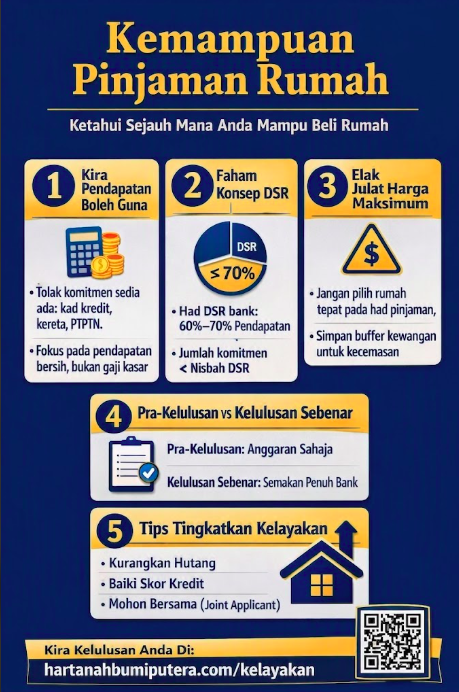
The first step is to calculate your net monthly income after deducting all existing financial commitments, credit card payments, car loans, personal loans, PTPTN, and so on. Many people only focus on their gross income when making estimates, whereas banks assess based on income after deducting all these commitments. The remaining amount after all these deductions determines how much more room you have for a new home mortgage.
Don't forget to also include basic living expenses, current rent (if applicable), utility bills, insurance, and family expenses, even though banks do not always include all of these directly in the official DSR calculation. Realistic planning means you assess not only "how much the bank is willing to lend," but also "how much is comfortable for me to pay each month" without affecting your quality of life or emergency savings.
Understand the Concept of DSR (Debt Service Ratio)
DSR or Debt Service Ratio is the ratio between your monthly commitments, including the new house installment you are applying for, compared to your monthly income. Banks in Malaysia generally set different maximum DSR limits, usually ranging between 60% to 70% of your income, depending on your income tier and the bank's internal policy. This is not the same fixed number across all banks; some banks are stricter for low-income applicants, and more flexible for high-income applicants.
As a simple example (not an official bank calculation): if the allowed DSR limit is 70% and your net income is RM5,000 per month, your total monthly debt commitment, including the new house installment, should not exceed approximately RM3,500. However, the actual approved amount depends entirely on the credit assessment and the specific bank's policy you are applying to.
Avoid the "Maximum Price Range" Trap
Another common mistake is taking the maximum loan approval amount as your target house price. If the bank approves a loan up to RM500,000, this does not mean you should look for a house exactly priced at RM500,000. The buffer between the maximum approved installment and the installment you can comfortably afford is important to handle future increases in interest rates/profits, unexpected expenses, or changes in income. Many financial planners recommend looking within a range slightly below the maximum approved limit, not exactly at that limit.
Preliminary Approval vs Actual Approval — Don't Get Confused
Many buyers think that a "pre-approval" from a bank means their loan is definitely approved. In reality, pre-approval is just an initial estimate based on the information you provided, your income, commitments, estimated credit score, it is not a guarantee. The actual approval only happens after the bank conducts a full check, including a CCRIS/CTOS check, official income verification, and the property valuation requested. The final approved loan amount may differ from the initial pre-approval estimate.
Other Factors Considered by Banks
- Credit score (CCRIS/CTOS) — late payment records or outstanding debts can affect approval even if your DSR is low.
- Type of employment — salaried employees are usually easier to verify compared to self-employed or freelance workers, who may need additional documents.
- Loan term (tenure) — a longer term reduces monthly installments, but increases the total interest/profit paid.
- Finance margin (Margin of Finance) — the limit of the loan percentage compared to the property price approved by BNM for specific buyer/property profiles.
Practical Tips to Improve Your Loan Eligibility
If your estimated eligibility is lower than expected, there are several steps that can usually help before you apply officially:
- Reduce existing commitments — clarify or reduce outstanding credit card balances and personal loans several months before applying, as this directly lowers your DSR.
- Consider a joint applicant — applying together with a partner or eligible family member can combine incomes, increasing the loan amount that can be approved.
- Improve your credit score — pay all bills and installments on time at least 6-12 months before applying, as payment history is a major factor in CCRIS/CTOS assessments.
- Consider a longer loan term — if your eligibility is limited by DSR, applying for a longer term (subject to age/tenure limits by the bank) can reduce monthly installments and potentially increase the eligible loan amount.
Remember that each of these steps has different effects depending on your personal financial profile — there is no one-size-fits-all formula, so consider this as a starting point for discussions with your bank loan officer or financial advisor.
Instead of guessing, the most accurate way to know the range of house prices you can afford is to use our DSR/Lending Capacity Calculator at /analisis-pelaburan-ejen — enter your income and existing commitments to get an estimate of your loan eligibility before you start visiting any properties.