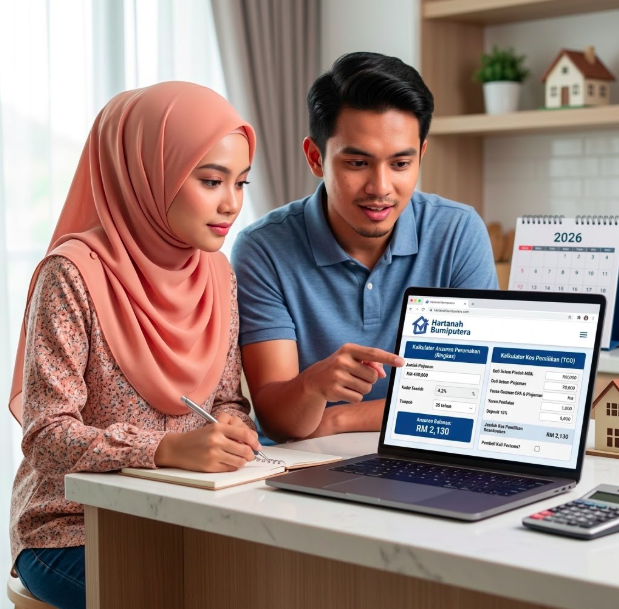
For most Malaysians, buying a home is the biggest purchase in life — and most buyers only fully understand mortgage figures AFTER they sit at the bank counter. This article is a basic guide for you to estimate yourself first, use Hartanah Bumiputera's free calculator, before going to the bank.
Step 1: Estimate Monthly Installments
Start with the Mortgage Installment Calculator — enter the price of the house you are interested in, deduct the deposit (usually 10%), and see how much the monthly installments would be on various loan terms (20, 30, 35 years) and different interest rates.
Step 2: Check Your DSR (Debt Service Ratio)
Banks don't just look at the new mortgage installment separately — they calculate the ratio OF ALL your monthly debt commitments (car loan, credit card, personal loan, AND the new home installment) compared to your gross monthly income. Use the DSR Calculator to estimate whether your profile is likely to pass the bank's DSR limit (usually around 60-70%, depending on the bank and income profile).
Step 3: Calculate Additional Costs (Not Just the Deposit)
Many first-time buyers are surprised by additional costs outside the 10% deposit — stamp duty, legal fees, valuation fees. Use the Ownership & Loan Installment Cost Calculator (TCO) to see ALL upfront costs at once, including stamp duty exemption if you qualify as a first-time buyer.
Step 4: Compare Conventional vs Islamic
All home loan calculators on Hartanah Bumiputera support three types of financing — Conventional, Islamic Decreasing Balance (Musyarakah Mutanaqisah), and Islamic Fixed Profit (BBA) — so that you can compare different structures before choosing a bank/product.
Step 5: Check Government Assistance Schemes
Depending on your income and employment profile, you may be eligible for schemes such as LPPSA (public servants), SJKP Madani (irregular/independent income), or various state housing schemes — all of which also have their own eligibility calculators on this portal.
This calculator is for planning purposes only — actual loan approval depends on the bank's full credit assessment (CCRIS/CTOS, employment history, income documentation). Obtain a Principle Approval (Letter of Undertaking) from the bank for confirmation before signing the S&P.