Real estate investment is often touted as a golden ticket to achieve financial freedom and early retirement. On various Malaysian property portals and finance forums, stories of investors who generate huge profits through resale (flipping) or passive income in the hundreds of thousands of Ringgit are easily found. However, the dark side of this investment is rarely exposed.
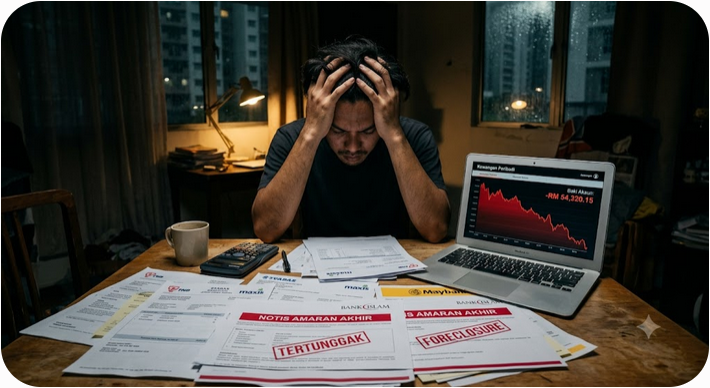
According to statistics from the Malaysian Insolvency Department, failure to pay housing loans and personal loans taken for real estate investment are among the main reasons individuals are declared bankrupt. Real estate is an illiquid asset (cannot be quickly converted into cash). When investment starts to face problems, it is very difficult for you to exit without incurring significant losses.
Here is how wrong property investment can trap you into bankruptcy:
1. Hidden Dangers of Auction Properties
Joining a competitive bid for auction properties that appear much cheaper than market price, such as a three-storey terrace house in a prestigious area like Cyberjaya, can feel like a big win. However, auction properties are sold "as is" (as-is, where-is basis), yang membawa risiko kewangan yang amat besar jika pemeriksaan rapi (due diligence) diabaikan:
Non-Refundable Deposit: If you win the bid and pay a 10% deposit, but fail to obtain bank loan approval within a tight timeframe (usually 90 to 120 days due to hidden caveats or low bank valuation), your deposit will be entirely forfeited.
Outstanding Hidden Costs: Buyers are often surprised to find themselves liable for outstanding debts of tens of thousands of Ringgit in maintenance fees, property taxes, or utility bills left behind by the previous owner.
Cost of Evicting Occupants: If the auctioned house is still occupied by the stubborn original owner or a tenacious tenant, you will have to bear the expensive and time-consuming legal costs to obtain a court order to evict them.
2. Trauma of Abandoned Projects
Buying under-construction property from a developer with a poor track record is a big gamble. In Malaysia, there are many "sick project" cases where construction halts halfway due to the developer's poor financial management.
As soon as you sign the Sales and Purchase Agreement (SPA) and the bank starts releasing staged payments (progressive release) to the developer, your loan commitment has already begun.
If the project is abandoned, you are legally still responsible for paying monthly installments to the bank for a house that does not exist. You cannot rent it out to cover the costs, and you cannot sell it. The financial burden—paying rent for an existing house and at the same time paying installments for the abandoned project—will quickly drag you into a bankruptcy crisis.
3. "Multiple Submission" Trap and Over-Leveraging
A controversial and highly risky tactic often promoted by some unlicensed "property gurus" is submitting several housing loan applications simultaneously to different banks (multiple submission). The aim is to manipulate the Debt Service Ratio (DSR) limit and buy three or four houses at once with high financing margins.
Illusion of Rental Guarantee: This strategy relies entirely on the assumption that all these properties will be rented out immediately at high prices to cover the large monthly installments.
Realiti Sebenar: Jika pasaran meleset, atau hartanah tersebut terletak di kawasan yang mengalami lambakan unit (oversaturated), pelabur tiba-tiba terpaksa membayar RM8,000 hingga RM10,000 setiap bulan menggunakan duit poket sendiri. Tanpa rizab tunai yang kukuh, kuasa bertahan (holding power) pelabur akan lebur dalam masa beberapa bulan sahaja, sekali gus membawa kepada tindakan lelongan dan insolvensi.
4. Kebimbangan Terhadap Kenaikan Kadar OPR
Ramai pelabur membuat anggaran pulangan berdasarkan kadar faedah bank yang paling rendah semasa mereka membeli rumah. Apabila Bank Negara Malaysia (BNM) menyemak naik Kadar Dasar Semalaman (OPR), Kadar Pembiayaan Asas (BFR/BLR) bank-bank komersial akan turut meningkat.
Kenaikan OPR yang kelihatan kecil, contohnya sebanyak 0.25% hingga 0.50%, boleh menambah kos ratusan Ringgit kepada ansuran bulanan bagi satu-satu hartanah.
Jika aliran tunai sesuatu hartanah sebelum ini hanyalah sekadar "cukup-cukup makan" daripada hasil sewa, kenaikan OPR akan menukarkannya menjadi liabiliti aliran tunai negatif secara mendadak. Bagi pelabur yang memegang beberapa hartanah dengan pinjaman maksimum, lonjakan kos sara hidup ini akan menipiskan simpanan mereka dengan pantas.
5. Over-Investment (Over-Investment) and the Illusion of "Flip" Price
The practice of property flipping that is buying a house with the intention of reselling it quickly at a higher price is often depicted as a shortcut to wealth. However, relying on this strategy is extremely risky in the current economic landscape.
Cooling-Down Measures for the Market: The activity of flipping is generally not encouraged because it suddenly increases market prices, making houses unaffordable for local residents. The Malaysian government has implemented various cooling-down measures for the property market (such as RPGT/CKHT taxes). Due to these controls, buying and selling property for quick profit is no longer a stable or recommended strategy.
Trap of Over-Investment: Many buyers with high aspirations fall into buying several houses under construction (under-con) or secondary market (sub-sale) at the same time, assuming they can sell them (flip) before the actual financial commitment begins.
Killing Holding Costs: If a buyer fails to find a market quickly due to a slow market or a price set too high, the investor suddenly finds themselves trapped with several active housing loan commitments. The pressure to pay various bank installments, maintenance fees, and taxes without any incoming cash flow will deplete their emergency funds, forcing them to fail to pay debts and ultimately declared bankrupt.
Conclusion
Real estate investment indeed requires a very large amount of capital. Unlike liquidating shares or trust units, you cannot sell a house within one night to settle urgent debts. The line that distinguishes a profitable investment portfolio from bankruptcy lies in in-depth market research, preparation of emergency funds for at least six months, and high discipline to avoid speculative buying tactics and exceed actual financial capacity.