Many Bumiputera property buyers are confused between two commonly used terms that seem similar: "Malay Reserved Land" and "Bumiputera Lot". Although both relate to the Malay/Bumiputera status, legally they are two very different things, and misunderstanding this can lead buyers to make wrong decisions when buying or selling property.
Malay Reserved Land — Land Status, Not a Project Condition
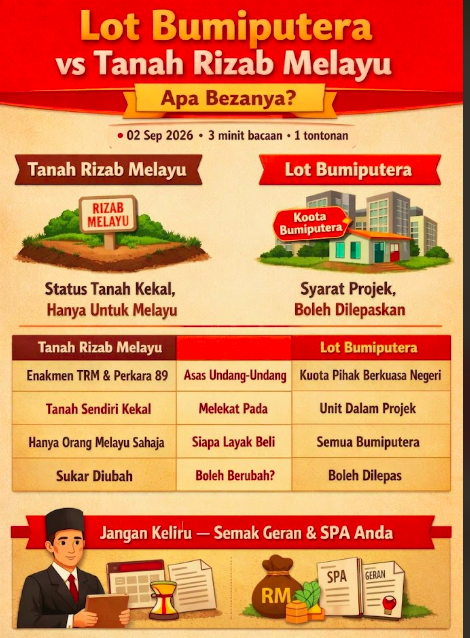
Malay Reserved Land (TRM) is a category of land that existed before independence, under the Malay Reservations Enactment of each state. This status is protected at the federal constitution level through Article 89 and Article 160, which define who is considered "Malay" for the purpose of reserved land, usually referring to someone who practices Islam, speaks the Malay language, follows Malay customs, and was born in/or originated from the Federation or Singapore according to historical definitions.
This means that the TRM status is attached to the land itself, not any particular developer's project. The land ownership will clearly state the word "Malay Reserved" on the title. Generally, land with this status cannot be transferred, sold, mortgaged or assigned to any party who is not Malay according to the enactment definition, even if the buyer is a non-Malay Bumiputera (e.g., Bumiputera from Sabah or Sarawak who are not Malay). The process of changing this status, if any, is very strict and rarely approved, as it requires amendments at the state authority level.
Bumiputera Lot — Developer Quota Condition, Not a Land Status
"Lot Bumiputera" is something entirely different. It is not a land status, but a quota condition imposed by the State Authority on a development project, usually a percentage of units in the project (for example 30% of the total units) designated for sale to Bumiputera buyers only, as part of the state's Bumiputera property ownership policy.
This condition is usually accompanied by a price discount, and sometimes a lock-in period before the unit can be sold to non-Bumiputera, or requires approval/consent from the State Authority before transfer is allowed. However, and this is important, after the lock-in period ends, or after obtaining the release of the Bumiputera condition, the unit can usually be sold to anyone, including non-Bumiputera. This is completely different from TRM, which generally remains a continuous restriction on the land itself.
Main Differences Online
- Legal basis: TRM — State Malay Reserved Land Enactment & Article 89/160 of the Federal Constitution; Lot Bumiputera — administrative/quota policy of the State Authority for specific development projects.
- Attached to: TRM — the land itself, continuously; Lot Bumiputera — specific unit/lot within a project, subject to the project's sales conditions.
- Who is eligible to buy: TRM — only those who meet the definition of "Malay" under the relevant enactment; Lot Bumiputera — any Bumiputera buyer, broader scope depending on state policy.
- Can it change? TRM — very difficult to change status; Lot Bumiputera — restrictions are usually temporary or can be waived through official consent.
Common Mistakes to Avoid
One common mistake is buyers assuming that because they are purchasing a "Bumiputera unit" in a condominium or housing estate, the unit automatically has the same legal protection as Malay Reserved Land. This is not true, the Bumiputera status on a regular property unit is merely a contractual condition that can expire or be waived, whereas TRM is a statutory restriction that is far stricter and almost impossible to change.
The second mistake is assuming that all states follow the same regulations. Some states impose a restriction period of several years for Bumiputera units only, while other states may not impose any restriction period at all but require consent for every transaction. This also applies to TRM, although the basic concept is uniform under the Federal Constitution, daily administration and certain exemptions can differ according to each state's Malay Reserve Enactment. Therefore, the "Bumiputera" label on property listings does not fully inform you of the applicable restrictions; you need to investigate further.
Why This Matters — Check Your Actual Documents
The actual rules — discount percentages, resale restriction periods, whether non-Bumiputera can purchase directly or not, can vary by state and also depend on specific conditions in the Sale and Purchase Agreement (SPA) or the developer's approval letter for that unit. Do not make assumptions based on what you hear about other projects or states. Always refer to the land title (check "land use category" and "interest restrictions" on the title deed), SPA, and letters from the developer or the relevant State Authority regarding your specific unit — or seek advice from a property lawyer before making a decision.
Looking for a valid and clearly defined Bumiputera property? View current Bumiputera property listings at /hartanah to start exploring options that match your eligibility.