Before the bank approves your home loan, they need to ensure that the property value to be purchased matches the loan amount requested. For this reason, the bank will appoint a registered valuer to conduct an official valuation of the property, and this cost is charged to the buyer as one of the mandatory fees in the house buying process. Many buyers are unaware of this fee until it appears in the list of costs to be paid, and some are confused, thinking that this valuation is free because it is "for the bank's interest". The Property Valuation Fee Calculator on hartanahbumiputera.com helps you estimate this cost accurately according to the official scale in force.
What Is Valuation Fee and Why It Is Mandatory
The valuation fee is paid to a registered valuer who provides an official valuation report (valuation report) for the property to be purchased. This report becomes the main reference for the bank to determine whether the property value is sufficient to support the loan amount requested. Without a valuation report, the bank will not approve the loan, so this fee is practically mandatory for almost all home purchases financed by a loan. The cost is calculated according to the official scale under the Valuers, Assessors, Real Estate Agents and Property Managers Act 1981, and it is tiered according to the property value, that is, the higher the property value, the lower the percentage rate charged on the additional portion.
This valuation is important not only for the bank, but also for the buyer themselves, as it provides an objective overview of whether the agreed price with the seller is reasonable based on the current market value. If the valuer's assessment is significantly lower than the agreed purchase price, the bank may only approve the loan based on the valuation amount, meaning the buyer will need to cover the difference in cash from their own pocket.
Jurunilai berdaftar yang menjalankan penilaian ini mesti berdaftar secara sah dengan Lembaga Penilai,
Pentaksir, Ejen Harta Tanah dan Pengurus Harta Malaysia (LPPEH), memastikan laporan yang dihasilkan mematuhi piawaian profesional yang diiktiraf. Proses penilaian biasanya melibatkan lawatan fizikal ke tapak, semakan transaksi hartanah setanding di kawasan berdekatan, dan penilaian keadaan fizikal bangunan sebelum laporan akhir dikeluarkan kepada bank.
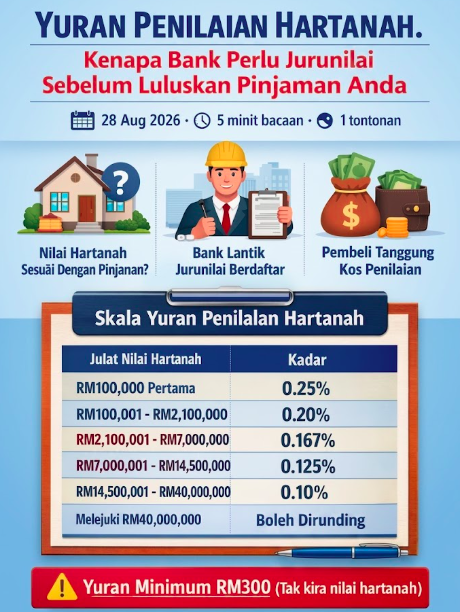
Official Graded Scale
Below is the full valuation fee scale used:
| Property Value Range | Rate |
|---|---|
| First RM100,000 | 0.25% |
| RM100,001 - RM2,100,000 | 0.20% |
| RM2,100,001 - RM7,000,000 | 0.167% |
| RM7,000,001 - RM14,500,000 | 0.125% |
| RM14,500,001 - RM40,000,000 | 0.10% |
| Exceeding RM40,000,000 | Negotiable (calculator assumes 0.10%) |
Just like MOT stamp duty, this is a tiered system, so each portion of the property value is subject to a different rate according to its range, not a single rate applied to the total value. One important thing: no matter how low the property value, there is a minimum fee of RM300 charged, so even for very low-value properties, this fee will not drop below RM300.
This tiered scale is designed so that the percentage rate decreases as the property value increases, because the evaluation work for high-value properties does not necessarily become five or ten times more complex than for low-value properties. This makes the evaluation fee more fair in proportion for luxury properties compared to if a single rate was applied across the entire value scale.
Calculation Example: RM350,000 Apartment vs RM3,000,000 Mansion
Let's compare two properties with very different values to see how the effective rate changes.
RM350,000 Apartment
- First RM100,000 x 0.25% = RM250
- Remaining RM250,000 (350,000 - 100,000) x 0.20% = RM500
- Total evaluation fee = RM250 + RM500 = RM750
- Overall effective rate = RM750 / RM350,000 = approximately 0.21%
RM3,000,000 Mansion
- First RM100,000 x 0.25% = RM250
- Next RM2,000,000 (100,001 to 2,100,000) x 0.20% = RM4,000
- Remaining RM900,000 (2,100,001 to 3,000,000) x 0.167% = RM1,503
- Total evaluation fee = RM250 + RM4,000 + RM1,503 = RM5,753
- Overall effective rate = RM5,753 / RM3,000,000 = approximately 0.19%
See how even though the total ringgit fee is much higher for the bungalow (RM5,753 compared to RM750), the actual effective rate is actually slightly lower (0.19% compared to 0.21%) because the higher value portion is subject to a diminishing percentage rate. This is a common pattern in such a tiered system, high-value properties tend to pay an average rate slightly lower than low-value properties. For even more luxurious properties, say valued at RM8,000,000, the effective rate will decrease further because part of its value falls into the 0.125% tier, showing this trend of decreasing effective rates continues at higher values.
As an additional comparison, say a low-cost house valued at RM80,000. According to the scale, 0.25% x RM80,000 is only equivalent to RM200, but because the minimum fee of RM300 applies, the buyer still needs to pay RM300, not RM200. This example shows that the minimum fee really has a significant impact for very low-value properties, so don't assume that valuation fees always scale directly with the percentage rate alone.
Common Questions About Valuation Fees
Who pays the valuation fee, the buyer or the bank? Although the bank hires the valuer, this cost is usually borne by the buyer as part of the house purchase cost.
Do I need to pay a valuation fee if buying in cash without a loan? Usually not required, because this valuation requirement arises due to the bank's need to approve the loan. However, some cash buyers choose to get an independent valuation for other reasons, such as estate planning or investment assessment.
Kenapa yuran minimum RM300 dikenakan walaupun hartanah murah? Ini kerana kerja penilaian
melibatkan kos asas yang tetap seperti lawatan tapak, penyediaan laporan dan semakan pasaran, tak kira berapa rendah nilai hartanah tersebut.
Berapa lama proses penilaian biasanya mengambil masa? It varies according to the valuer and location, but usually involves a site visit over the course of a few working days, followed by the preparation of a full report before it is submitted to the bank for loan approval verification.
Practical Tips and Common Mistakes
- This fee is usually paid by the buyer, not the bank. Although the bank appoints the valuer, this cost is typically passed on to the buyer as part of the house purchase cost.
- Check if the fee can be included in the loan. Some bank packages allow the valuation fee to be financed once, reducing the need for immediate cash.
- Don't be fooled by market value vs purchase price. The valuer assesses based on current market value, which may differ slightly from the price you agree with the seller, and this can affect the loan amount approved by the bank.
- Remember the minimum fee is RM300. Even for very low-value properties, don't assume this fee will be nearly zero; it will not drop below RM300 regardless of how small the property's value.
- Have cash ready for valuation differences. If the valuer's report shows a value lower than the purchase price, be prepared to cover the difference in cash because the bank will only finance based on the lower value.
- Verify that the appointed valuer is properly registered. This ensures the valuation report is accepted by the bank without any issues, and avoids delays in your loan approval process.
- Understand that this valuation differs from the agent's estimate. The agent's price estimate during the buying process is not the same as the official valuation report from a registered valuer required by the bank.
Understanding this scale helps you accurately predict valuation costs, without being surprised when the valuer's report and fee bill arrive.
Try this calculator for free at Property Valuation Fee Calculator.
Note: The figures above are estimates for planning purposes only and are not financial advice. Actual fees may vary according to valuer and bank conditions; please confirm with your bank or registered valuer.