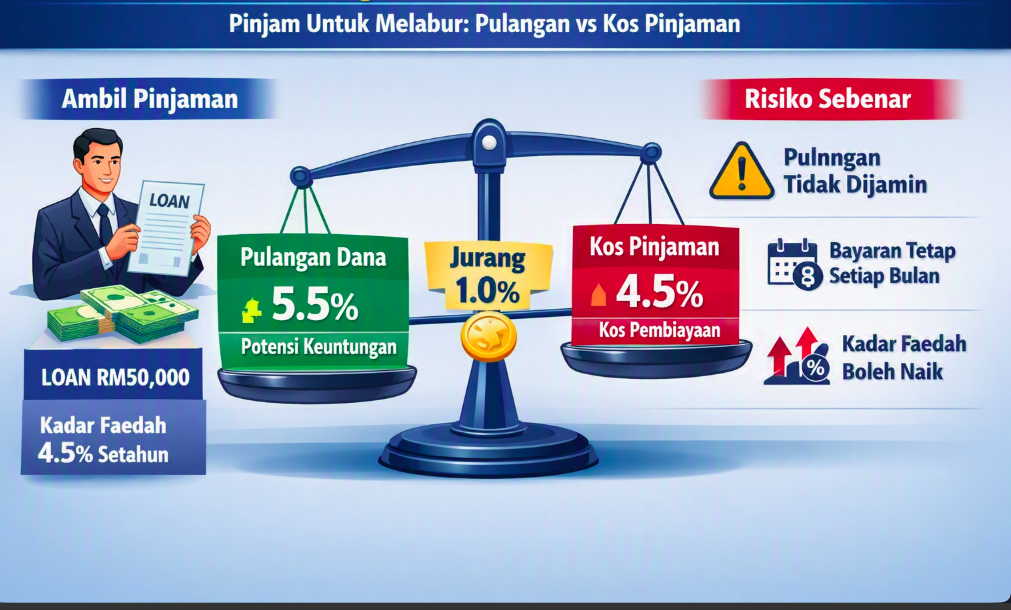
Have you ever heard of a friend who "took a loan to invest in a unit trust"? This is not a new strategy; it is called unit trust financing, and it is based on a simple bet: the returns from the invested funds must exceed the cost of the loan taken. It sounds simple on paper, but this strategy carries risks that are usually not fully understood by ordinary borrowers. The Unit Trust Financing Calculator helps you clearly see whether the gap between the loan cost and the expected returns is really worth it.
What Is Unit Trust Financing
Unit trust financing is a leveraged investment strategy, where you borrow a certain amount of money specifically to invest in a unit trust fund, hoping that the returns or dividends generated by the fund exceed the cost of the loan interest. If it succeeds, you "capture" the difference between the two rates, a concept often called "positive carry" or arbitrage investment. This is completely different from investing using your own cash, because in financing, you incur a real debt obligation to the financial institution, regardless of how the fund performs later.
This calculator takes basic inputs: financing amount, annual financing interest rate (default illustration 4.5%), financing period, and the expected return or dividend rate paid by the unit trust fund (default illustration 5.5%), to provide an overview of the gap between the cost and returns throughout the financing period.
This strategy is often offered by financial institutions and unit trust agents as a way to "accelerate" the growth of investment portfolios, especially for those with strong fixed incomes but who do not have large amounts of capital to invest outright. Its appeal is clear: with a single loan amount, someone can start investing in a larger amount than they would be able to if they had to wait to accumulate cash first. However, this appeal must be weighed carefully against the greater risks involved.
The Actual Mechanism and Risks of This Strategy
The logic behind this strategy is simple mathematically: if the loan rate is 4.5% per year, and the unit trust fund generates a return of 5.5% per year, the positive "spread" of 1.0 percentage point is the net expected profit from this strategy after subtracting interest costs. However, this is where the main risk lies and must be understood honestly, unit trust funds are not like fixed deposits that guarantee a fixed return. Fund performance changes every year according to market conditions, and there is no guarantee that actual returns will reach the assumed 5.5%.
If in any given year, the actual return of the fund falls below the financing rate, the borrower actually loses money in that leveraged position, even though technically they are "investing". This is because the repayment of the loan and its interest must still be settled according to the schedule, regardless of the fund's performance that year. This is the fundamental difference between investing with your own cash versus investing with borrowed money; a loss in cash investment only means the value of your portfolio drops, but a loss in leveraged investment means you are still in debt to the bank, no matter what the market conditions are.
There is also a second risk that is less discussed, namely the floating interest rate risk. Some unit trust financing uses interest rates that can change according to current market rates, not a fixed rate throughout the financing period. If market interest rates increase in the future, the margin or spread that was originally positive can shrink, or even become negative, even if the fund's returns remain unchanged. This adds another layer of uncertainty to this already risky strategy.
Calculation Example: RM50,000 Financing Over 10 Years
Say someone takes a unit trust financing of RM50,000 at a financing interest rate of 4.5% per year, over a 10-year period, with the assumption that the invested fund generates a dividend rate of 5.5% per year.
Spread or margin: 5.5% minus 4.5% produces a positive spread of 1.0 percentage point per year. If this assumption remains consistent throughout the 10-year period, this margin accumulates into a significant net benefit compared to the financing costs that need to be borne, especially when the compounding effect on fund returns is also taken into account over the long period.
However, this scenario only occurs if the assumption of 5.5% remains consistently true every year for 10 years, a condition that is rarely encountered in real financial markets. In reality, some years may yield returns higher than 5.5%, while other years may yield returns lower than the 4.5% financing rate, or even negative. In such years, the borrower still needs to pay the full financing instalments as usual, even though the value of the fund units held may temporarily decline. This is why this calculator is important not just to view the best-case scenario, but to truly understand the scale of risk being undertaken if assumptions do not match reality.
To give a clearer picture, imagine two contrasting scenarios. In the first scenario, the fund consistently generates 5.5% annually over 10 years, and the borrower enjoys a net benefit from a 1.0 percentage point spread each year, accumulating into a fairly large amount by the end of the period. In the second scenario, three out of the ten years provide negative or below 4.5% returns, while the other years provide higher returns to balance out the overall average. Although the overall average may look similar in both scenarios, the borrower's actual experience over the 10-year period is very different, especially in terms of financial pressure during the bad years, where fixed payments must still be made even as the investment value is declining.
Tips Before Considering This Strategy
- Don't regard the fund's dividend rate as a promise. It is declared each year based on the fund's actual performance, not a fixed rate like fixed deposits.
- Understand your ability to pay installments even if the fund provides low returns. Ensure you can cover the repayment of financing even in years when the fund performs poorly.
- Understand the spread is not guaranteed profit. A positive spread of 1.0 percentage point is merely an illustrative example, not a guarantee of actual annual results.
- Check the financing terms carefully. Interest rates, terms, and upfront payment conditions may vary according to financial institutions, check all details before signing anything.
- This strategy is more suitable for borrowers who understand the risks. If you are uncomfortable with the possibility of losses in bad years, consider investing using cash only, without leverage.
- Set aside an emergency fund. Don't use all your surplus funds to pay financing installments, keep an emergency fund separate to cover installments in case of temporary income disruptions.
- Compare several financing offers. Interest rates and terms between financial institutions may differ, so don't accept the first offer without comparing other options first.
Ultimately, this calculator is not meant to convince you to take on financing, but to help you make a more informed decision. By clearly seeing the gap between financing costs and expected returns, and understanding that this gap is an assumption and not a guarantee, you are in a better position to assess whether this strategy is truly suitable for your risk profile and personal financial situation, rather than simply following a strategy that is popular among friends or investment agents.
Try this calculator for free at Unit Trust Financing Calculator.
This calculator provides illustrative estimates based on interest rates and assumed returns, not a guarantee of actual fund performance or investment advice. Please seek advice from a licensed investment advisor before making an actual financing decision.