When you look at the mortgage repayment schedule, have you ever noticed why in the early years, most of your monthly instalments go towards interest, not the principal of the loan? This isn't a miscalculation, it's actually how home loans in Malaysia work, called the reducing balance method. Our Housing Instalment Calculator shows you exactly how this method works, and what your monthly instalments should be.
What this calculator helps you calculate
This calculator calculates your monthly home loan instalments based on three inputs: loan amount, interest rate, and loan term (tenure, between 5 to 35 years, also subject to the age limits set by the bank). The result is not just a single monthly instalment figure, but also an overview of the total interest you will pay throughout the loan period, information that is very important for long-term financial planning.
If you don't have the interest rate quoted by the bank itself, this calculator can generate an illustrative rate based on the Overnight Policy Rate (OPR) currently set by Bank Negara Malaysia, plus a typical bank loan margin of 1.4 percentage points. This gives you a rough idea of a reasonable rate even if you haven't yet discussed it with the bank.
OPR is the base rate set by Bank Negara Malaysia as the basis for loan rates across the national banking system. When OPR increases or decreases (usually decided during regular monetary policy meetings), banks also adjust their loan rates, including existing floating-rate home loans. The 1.4 percentage point margin added on top of OPR represents the bank's profit and operational costs, which may vary slightly from one bank to another depending on the borrower's risk profile, type of loan product, and the bank's pricing strategy at that time.
How the reducing balance method works
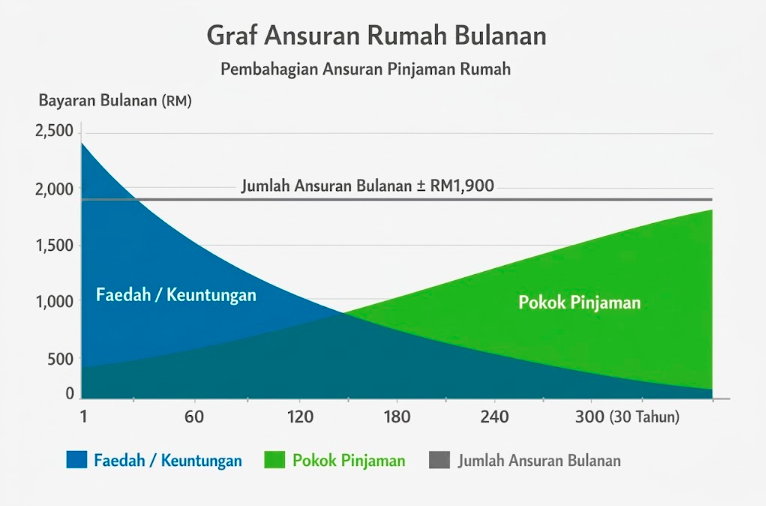
Under the reducing balance method, interest/profit is calculated ONLY on the outstanding loan balance for that month, not on the original loan amount. This means that every time you make a payment, part of it goes towards the interest for that month, and the remainder reduces the loan principal. Since the outstanding loan balance decreases month by month, the amount of interest charged also decreases, and automatically more of the same monthly instalment goes towards reducing the loan principal as time passes.
This is why, in the early years of the loan, the interest ratio in each instalment is higher compared to the principal, and this pattern reverses towards the end of the loan period.
This is VERY different from the flat rate method used for car loans and personal loans (discussed in our separate article). In the flat rate method, interest is calculated on the ORIGINAL loan amount throughout the entire term, without taking into account the outstanding balance that should decrease. This makes the flat rate method relatively more "expensive" compared to the reducing balance method for rates that look the same numerically. Fortunately, home loans in Malaysia use the more fair reducing balance method for borrowers.
Another important implication of the reducing balance method: since the interest calculation depends entirely on the outstanding balance, any additional payments you make on the principal of the loan (outside of regular monthly installments) will continue to reduce that outstanding balance, and thus reduce the amount of interest for the following months. This is completely different from the flat rate method, where the total amount of interest is already set from the beginning, regardless of how quickly you repay.
This is also why borrowers are encouraged to make additional payments (if possible) early in the loan term, not late, because the interest reduction effect from early additional payments is greater compared to the same additional payments made in the later years, considering that the outstanding balance at the beginning of the term is much larger.
Example: RM400,000 loan over 30 years
Let's take an example of a RM400,000 home loan over 30 years. Suppose you don't have a rate from the bank, so the calculator generates an illustrative rate based on the current OPR plus a 1.4 percentage point margin, resulting in an illustrative rate of around 4.0% per year for the purpose of this example.
Using the reducing balance method at a rate of 4.0% per year over 30 years (360 months), the monthly payment for a RM400,000 loan will be around RM1,900 per month (estimated using the standard amortisation formula).
Over the entire 30-year period, the total amount paid (monthly payments multiplied by 360 months) will far exceed the original RM400,000, with the total interest paid being around RM280,000 to RM290,000, depending on the exact rate used. This means the total amount you repay to the bank (principal plus interest) is almost double the original loan amount, an important reality to understand before taking out a long-term loan.
If you shorten the loan term, for example to 20 years, monthly payments will increase, but the total interest paid over the term will be much lower, because the loan balance reduces faster.
This comparison is important to understand: over a 20-year term (240 months) for the same RM400,000 loan at a rate of 4.0%, monthly payments will be higher than over a 30-year term, but because the term is shorter, the loan balance reduces much faster, the total accumulated interest is much lower compared to the 30-year term, possibly around RM180,000 compared to RM280,000 to RM290,000 over the 30-year term. This shows the classic trade-off between lighter monthly payments (longer term) versus lower overall costs (shorter term), a choice that depends on your own monthly cash flow comfort.
Practical tips and common mistakes
- Don't focus only on the monthly instalments. Low monthly instalments (with a long term) may look attractive, but the total amount of interest paid over the term could be much higher compared to a shorter term.
- Understand that OPR can change. If your loan is at a floating rate, your monthly instalments can increase or decrease when OPR changes, this calculator only provides an estimate based on the current OPR, not future projections.
- Additional principal payments have a big impact. Because of the reducing balance method, any additional principal payments directly reduce the total amount of interest for the remaining term, this is an effective strategy to reduce long-term costs.
- Compare rates from several banks. Small differences in interest rates, for example 0.2 to 0.3 percentage points, can mean thousands of ringgit difference in total interest over a 30-year term.
- Understand the bank margin above OPR. The 1.4 percentage point margin used by this calculator is a common/typical margin, actual banks may offer a lower or higher margin depending on your credit profile.
- Consider refinancing in the future. If market rates drop significantly after you take the loan, refinancing to a lower rate can save a large amount of total interest, but consider related costs (such as lock-in period penalties and new legal fees) before making a decision.
- Use this calculator to test several scenarios. Try entering different terms (for example 20, 25, and 30 years) for the same loan amount, this helps you clearly see the tradeoff between monthly instalments and total cost before making a final decision.
Try this calculator for free at Mortgage Payment Calculator.
Note: The payment amounts and total interest in this calculator are illustrative estimates based on standard amortization formulas, not official loan offers. Actual rates and terms will be determined by the bank after a full assessment of your application.