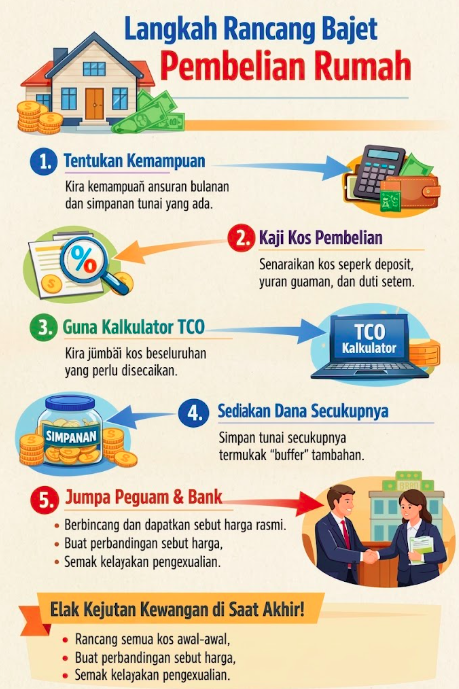
When people start planning to buy a house, the first thing that is usually calculated is the 10% deposit. But many are surprised when the lawyer sends a bill, because there are many other costs that need to be paid before the house key is handed over: legal fees, stamp duty, valuation fees, loan insurance, and many more.
If you don't plan early, many buyers end up having to find extra money at the last minute or delay important matters, and some even have to cancel their house booking because they didn't expect the actual amount of cash needed to be much higher. This is where the Total Cost of Ownership (TCO) calculator on hartanahbumiputera.com helps, because it compiles ALL costs related to property purchase in one clear list, so you can plan your finances with more peace of mind.
What the TCO Calculator Actually Calculates
The TCO calculator is not just a deposit calculator. It takes into account every item of cost that is usually involved in a house purchase transaction with the bank, namely:
- Deposit or upfront payment (usually 10%, and this is ALWAYS paid in cash, cannot be included in a loan)
- Legal fees for the Sale and Purchase Agreement (SPA)
- Legal fees for the Loan Agreement (if you are financing the purchase through a bank)
- Stamp duty on the Transfer Memorandum (MOT)
- Stamp duty on the Loan Agreement
- Registered valuer fees
- Estimated MRTA/MLTA insurance
- Bank processing fees
- Land registry and bankruptcy search fees
- Registration fees at the land office
- Various government costs and state authority consent fees (for leasehold land or Malay Reserved Land, if applicable)
The reason this calculator compiles all these items at once is so that you can get a realistic idea of how much cash you need to prepare before signing any documents, not just a rough estimate based on the deposit alone. Many real estate agents and lawyers actually use a similar list manually when advising customers, so this calculator essentially "copies" the process usually done by professionals, but in a form that you can use yourself in just a few minutes.
What is important to understand is that not all of these costs are mandatory for every transaction. For example, state authority consent fees only apply to leasehold land or Malay Reserved
Malay, whereas freehold property usually does not require it. Similarly, if you buy in full cash without a bank loan, items such as loan agreement legal fees, loan stamp duty, MRTA/MLTA insurance and bank processing fees are all not applicable. That is why this calculator is designed interactively, it adjusts the cost list according to your actual input.
How Each Cost Is Calculated
Some of these costs can be added once into your loan amount (depending on bank approval and the package offered), while others must be paid in cash, especially the deposit. Here is a summary of the main formula used:
- Legal fees (SPA and Loan Agreement): according to the 2023 Lawyer Remuneration Scale, with an additional 25% markup applied by this site since actual law firms often charge more than the minimum scale. The base scale is 1.25% for the first RM500,000 (minimum fee RM500), 1.00% for the remainder up to RM7,500,000, and can be negotiated above that (calculator assumes 1%).
- MOT Stamp Duty: tiered according to the house price, that is 1% for the first RM100,000, 2% for RM100,001 to RM500,000, 3% for RM500,001 to RM1,000,000, and 4% for any amount above RM1,000,000.
- Loan Agreement Stamp Duty: flat rate of 0.5% of the loan amount, without tiers.
- Valuation fees: tiered as well, that is 0.25% for the first RM100,000, 0.20% for RM100,001 to RM2,100,000, 0.167% for RM2,100,001 to RM7,000,000, and further decreasing at higher tiers, with a minimum fee of RM300.
Important note: starting from the 2026 Budget, first-time homebuying Malaysian citizens are eligible for FULL exemption of MOT stamp duty for properties valued at RM500,000 and below (subject to certain conditions). The TCO calculator automatically takes this exemption into account when you are eligible, so you don't need to calculate it manually. This can save thousands of ringgit compared to non-first-time buyers, and this saving continues to reduce the total TCO amount that needs to be prepared.
Items such as MRTA/MLTA insurance and bank processing fees vary according to the bank, loan package, tenure period and applicant's age, so there is no universal fixed percentage that can be applied. The calculator will provide a reasonable estimate based on your input, but the final figures will only be confirmed after the bank issues an official loan offer (Letter of Offer).
Calculation Example: RM450,000 House
Say you are a first-time homebuyer, interested in a terrace house priced at RM450,000, and you take a 90% loan (RM405,000) from the bank.
- Deposit (10%): RM450,000 x 10% = RM45,000 (cash, mandatory)
- SPA legal fee: RM450,000 falls in the first bracket (below RM500,000), so 1.25% x RM450,000 = RM5,625
- Loan agreement legal fee: RM405,000 also falls in the first bracket, 1.25% x RM405,000 = RM5,062.50
- MOT stamp duty: Since the house price is RM450,000 (below the RM500,000 threshold) and you are a first-time buyer, MOT stamp duty is FULLY EXEMPTED under the 2026 Budget = RM0 (without exemption, it would be approximately RM8,000)
- Loan agreement stamp duty: 0.5% x RM405,000 = RM2,025
- Valuation fee: First RM100,000 at 0.25% = RM250, remaining RM350,000 at 0.20% = RM700, total = RM950
The total costs calculated above alone already reach RM45,000 + RM5,625 + RM5,062.50 + RM0 + RM2,025 + RM950 = RM58,662.50. This does not include estimated MRTA/MLTA insurance, bank processing fees, title search and insolvency fees, and land registration fees, which the TCO calculator will automatically show based on your input so that the final amount you see is a more accurate and comprehensive figure. Imagine if this buyer IS NOT a first-time buyer, without MOT stamp duty exemption, the cash needed would increase by approximately RM8,000, making the overall TCO significantly higher.
Common Questions About Home Ownership Costs
Can all these costs be included in the loan? Not all. The deposit must be in cash. Other items such as legal fees and stamp duty can sometimes be financed together in a loan package, subject to bank approval.
Why is my TCO different from a friend who bought a house of the same price? This is common because of different eligibility exemptions (such as first-time buyer status), the insurance package chosen, and bank processing fees vary according to the bank and individual.
Do I need to prepare more than the calculator's figure? Yes, it is recommended to prepare a little extra (buffer) because costs such as insurance and processing fees can differ slightly from estimates until the official offer letter is issued.
Practical Tips and Common Mistakes
- Don't assume all costs can be included in a loan. The deposit must be paid in cash. Some banks allow legal fees and stamp duty to be included in the loan package (top-up), but this is subject to approval and may increase your monthly instalments.
- Check your eligibility for the 2026 Budget exemption early. The stamp duty exemption for first-time buyers has conditions, such as the SPA needing to be signed within the exemption period and only once in a lifetime for each buyer. Confirm with your lawyer before considering it as "certain".
- Prepare more than just an estimate. Costs such as insurance and bank processing fees vary according to the bank and package, so always prepare a little extra (buffer) compared to the calculator's number.
- Compare several loan packages. A lower interest rate sometimes comes with higher processing fees, so consider the total cost, not just the interest rate.
- Check the land title status earlier. If the desired property is a leasehold or Malay Reserved Land, ask the agent or lawyer whether the state authority approval fee applies, as this can add unexpected costs.
The TCO calculator helps you see the big picture before signing any agreement, so there are no financial surprises at the last moment.
Try this calculator for free at Ownership Cost & Loan Instalment Calculator.
Note: The figures above are estimates for planning purposes only and are not financial or legal advice. The actual rates, bank charges and stamp duty exemptions eligibility must be confirmed with your bank, lawyer and Inland Revenue Board (LHDN).