If you've ever heard a friend say "3% stamp duty" or "4%" for buying a house, that's actually not entirely accurate. The Stamp Duty on Transfer Memorandum (MOT) in Malaysia is calculated in a graduated manner, not a flat rate on the total house price. Misunderstanding this can lead you to estimate costs that are much higher (or lower) than they should be, and it can be confusing when comparing costs between houses priced differently. The MOT Stamp Duty Calculator on hartanahbumiputera.com calculates the actual amount according to the official graduated system, including taking into account the large exemption introduced in the 2026 Budget for first-time homebuyers.
What Is MOT Stamp Duty and Why It Matters
Every time the ownership of a property is transferred from the seller to the buyer, the transfer document (MOT) must be stamped before it can be officially registered at the land office. This stamp duty is imposed by the government based on the purchase price or market value of the property (whichever is higher), and it is one of the largest costs in the home buying process after the deposit itself. Because the amount can reach tens of thousands of ringgit for high-value homes, it is important for buyers to calculate it accurately before making a financial commitment.
Without full payment of the stamp duty and the document being certified, the transfer of ownership cannot be officially registered at the land office, meaning technically the property ownership has not fully transferred to your name. This makes MOT stamp duty not only a cost, but also a mandatory step that determines the legal validity of your property ownership.
Many buyers are also unaware that stamp duty is calculated based on the PURCHASE PRICE OR MARKET VALUE, whichever is higher, not just the figure agreed upon in the SPA. If the Inland Revenue Board (IRB) finds that the actual market value is significantly higher than the purchase price (for example, in transactions between family members), stamp duty will be calculated based on that higher market value, not the lower price agreed upon privately.
The Real Way It Is Calculated: A Tiered System
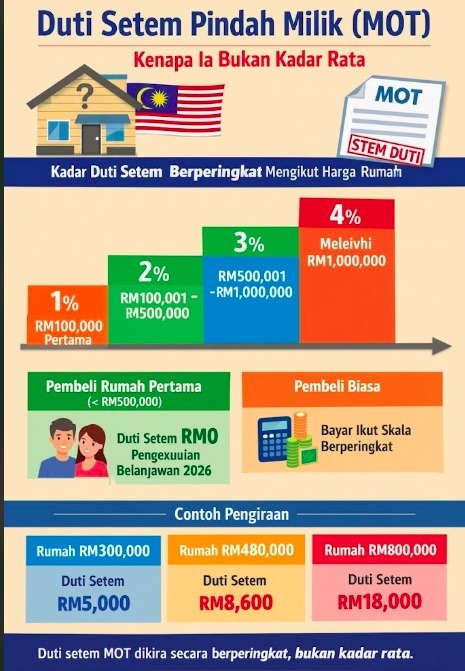
Stamp duty MOT is calculated like income tax, where each "tier" of price is subject to a different rate, and only the portion of the price within that tier is subject to that rate (not the entire house price being subject to the highest rate):
| Price Range | Rate |
|---|---|
| First RM100,000 | 1% |
| RM100,001 - RM500,000 | 2% |
| RM500,001 - RM1,000,000 | 3% |
| Exceeding RM1,000,000 | 4% |
This means a RM300,000 house IS NOT charged 2% on the entire RM300,000. Instead, the first RM100,000 is charged at 1%, and the remaining RM200,000 is charged at 2%. Many buyers mistakenly assume the highest rate (based on their house price) applies to the entire price, whereas in reality, only the portion falling within the highest tier is subject to that rate.
Big news for first-time homebuyers: The 2026 Budget introduces a FULL exemption of MOT stamp duty for Malaysian citizens buying their first home, provided the property price is RM500,000 and below. This means the stamp duty payable can be RM0 entirely, subject to conditions such as the SPA needing to be signed within the specified exemption period, and this exemption can only be claimed ONCE in a lifetime for each buyer. As additional information, foreign buyers are subject to a separate flat rate of 8% effective 1 January 2026, so if you are not a citizen or PR, please refer to other more relevant sources for this category.
Calculation Example: RM480,000 House, With and Without Exemption
Let's compare two scenarios for a RM480,000 house.
Scenario 1: First-time homebuyer, Malaysian citizen
Because the price of RM480,000 is below the RM500,000 threshold and the buyer is eligible as a first-time buyer, the full 2026 Budget exemption applies. MOT stamp duty payable = RM0.
Scenario 2: Non-first-time buyer (exemption not applicable)
- First RM100,000 x 1% = RM1,000
- Remaining RM380,000 (480,000 - 100,000) x 2% = RM7,600
- Total stamp duty = RM1,000 + RM7,600 = RM8,600
See the big difference here, RM8,600 versus RM0. For eligible buyers, this exemption is equivalent to a large discount that can be used for other needs such as furniture or initial renovation costs. Taking an example of a more expensive house, say RM800,000 (exceeding the exemption threshold), stamp duty will be calculated: RM1,000 (first tier) + RM8,000 (second tier, RM400,000 x 2%) + RM9,000 (third tier, RM300,000 x 3%) = RM18,000, showing how important the RM500,000 price limit is for exemption eligibility.
Also note the gap around the RM500,000 threshold. A first-time buyer purchasing a house for RM499,000 can enjoy full exemption (saving approximately RM8,980), while another buyer purchasing a house for just RM501,000, only RM2,000 more expensive, is not eligible for exemption and must pay in full according to the tiered scale. This is why it is important to negotiate the price carefully if your preferred property is near this threshold.
Common Questions About MOT Stamp Duty
Who is considered a "first-time buyer"? Generally, this means an individual who has never previously owned any residential property in Malaysia. Detailed criteria must be confirmed with a lawyer or LHDN as it may change according to official guidelines.
If the house price is RM520,000, can I still get some exemption? Based on the stated conditions, exemption only applies to properties priced at RM500,000 and below. Houses exceeding this threshold are not eligible for that exemption.
Who pays the stamp duty, the buyer or the seller? In Malaysia, the MOT stamp duty is usually paid by the buyer, unless otherwise agreed in the SPA.
When should the MOT stamp duty be paid? It is usually paid before or during the registration of the transfer documents at the land office, according to the schedule set by the lawyer handling your transaction.
Practical Tips and Common Mistakes
- Verify your "first-time buyer" status early on. This usually means you have never owned a residential property before in Malaysia; confirm the full criteria with a lawyer or the Inland Revenue Board of Malaysia (IRB) because detailed criteria can change.
- Don't assume all houses below RM500,000 are automatically exempt from stamp duty. This exemption is specific to first-time buyers only, not anyone buying a cheap house.
- Remember, this is a one-time lifetime exemption. If you have already used this exemption on a previous property purchase, it cannot be claimed again.
- Verify the exemption period. Conditions such as the date the Sale and Purchase Agreement (SPA) is signed must fall within the period set by the government, so don't delay the buying process too long.
- Avoid assuming the highest rate applies to the entire price. Remember this system is tiered like income tax, not a single flat rate.
- Be cautious of transactions below market value. If the purchase price is significantly lower than the actual market value, the IRB has the right to reassess and impose stamp duty based on the higher market value.
- Keep a copy of the exemption approval letter. If you are eligible for the first-time buyer exemption, ensure your lawyer keeps the official proof of approval for future reference, especially since it can only be used once in a lifetime.
Understanding this tiered system, and checking your exemption eligibility, can save you thousands of ringgit that can be redirected elsewhere in your home budget.
Try this calculator for free at Stamp Duty Transfer Calculator.
Note: The figures above are estimates for planning purposes only and are not tax or legal advice. Eligibility for exemptions, conditions and actual rates must be confirmed with the Inland Revenue Board (LHDN) and your lawyer.