After calculating the stamp duty MOT for the house to be purchased, many buyers think that is the only stamp duty they need to pay. Actually, if you finance the purchase through a bank loan, there is ANOTHER SEPARATE stamp duty imposed on the Loan Agreement itself. Many people mistakenly think that one stamp duty invoice covers both, and are surprised when they receive a second bill. Fortunately, the calculation for loan stamp duty is much simpler compared to MOT. The Loan Stamp Duty Calculator on hartanahbumiputera.com helps you estimate this cost quickly, so that there are no unexpected bills overlooked in your financial planning.
What's the Difference Between Loan Stamp Duty and MOT Stamp Duty
This is a frequently asked question, since both are called "stamp duty" but are imposed on completely different documents:
- MOT stamp duty is imposed on the property transfer document, and the amount depends on the HOUSE PRICE, calculated in a graduated scale (1% to 4% depending on the price range).
- Loan Agreement stamp duty is imposed on the loan contract between you and the bank, and the amount depends on the LOAN AMOUNT, not the house price, and is calculated at a flat rate (not graduated).
This is why you will see two separate stamp duty bills from your lawyer during the house buying process, one for the MOT and another for the loan agreement. Both must be paid before the documents can be officially registered. If you buy the property in full cash without a bank loan, you do not need to pay loan stamp duty at all since there is
No Loan Agreement that needs to be stamped, only the MOT stamp duty applies.
Another important difference: the MOT stamp duty is paid ONCE during the property transfer, while the loan stamp duty is also paid ONCE when the Loan Agreement is signed, not repeatedly every year throughout the loan period. So even if your loan term is 30 or 35 years, you only pay this loan stamp duty ONCE at the early stage of the transaction, not every year or every time you make a payment.
Simple Formula: Flat Rate of 0.5%
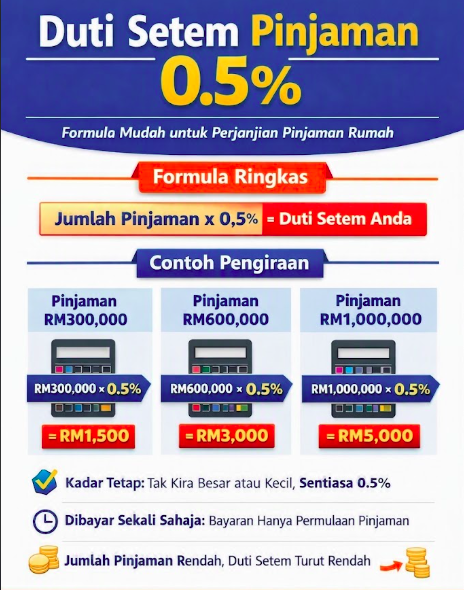
Unlike the MOT stamp duty which has four different rate stages, the Loan Agreement stamp duty is much simpler: it is imposed at a FLAT rate of 0.5% of the total loan or facility approved by the bank, without any stages or tiers. This means no matter how large your loan is, the 0.5% rate remains the same throughout the loan amount, there is no "surge" when the loan crosses certain thresholds, completely different from how MOT is calculated.
The simplicity of this formula makes financial planning easier, as you only need to multiply the loan amount by 0.5% to get an accurate estimate, without needing to break it down into several stages like the MOT stamp duty calculation. This also means, if the bank approves a lower loan amount than requested (for example, due to a smaller financing margin), your loan stamp duty will also decrease proportionally, without any need to worry about a "tier jump" effect.
Calculation Example: Three Different Loan Sizes
Let's see how this flat rate scales according to the loan amount, using three common examples:
| Loan Amount | Calculation | Loan Stamp Duty |
|---|---|---|
| RM300,000 | RM300,000 x 0.5% | RM1,500 |
| RM600,000 | RM600,000 x 0.5% | RM3,000 |
| RM1,000,000 | RM1,000,000 x 0.5% | RM5,000 |
Note this pattern: when a loan doubles from RM300,000 to RM600,000, stamp duty also doubles from RM1,500 to RM3,000. It scales linearly (straight), always exactly 0.5% regardless of how large the loan amount is. This is very different from MOT stamp duty, where a RM1,000,000 house may be subject to a different average rate compared to a RM300,000 house due to its tiered system. This simplicity allows buyers to estimate this cost quickly, without worrying about specific ranges or thresholds. As a comparison, if a RM1,000,000 loan were subject to MOT stamp duty (not loan stamp duty), the amount would be much higher because the tiered system reaches up to 4% in certain parts, this shows why it is important not to confuse the two types of stamp duties.
For buyers taking out combined loans (for example, a conventional loan mixed with a cooperative loan or other financing schemes), loan stamp duty is usually calculated separately for each Loan Agreement provided, since each is a different contract document that needs to be stamped individually. Therefore, if you have two separate loan facilities to finance one purchase, consider two separate loan stamp duty bills, not one combined bill based on the total amount.
Frequently Asked Questions About Loan Stamp Duty
Is loan stamp duty calculated based on the requested loan amount or the approved loan amount? It is calculated based on the actual amount of the loan or facility that is approved and stated in the Loan Agreement, not the initial amount requested.
If I take out a joint loan, will the rate change? The rate of 0.5% remains the same, it is calculated based on the total loan amount regardless of how many co-borrowers are involved.
Can the stamp duty on this loan be exempted like MOT stamp duty? The 2026 Budget exemption mentioned in another calculator is specifically for MOT stamp duty for first-time buyers; please confirm with a lawyer or LHDN whether any separate exemptions apply to loan stamp duty.
Does loan stamp duty apply to personal loans or credit cards? No, this calculator and formula are specifically for Property Loan Agreements, i.e., financing facilities directly linked to the purchase of a house or land.
Do I need to pay loan stamp duty separately from MOT stamp duty? Yes, both need to be settled separately, usually within approximately the same timeframe when your lawyer finalises your transaction.
Practical Tips and Common Mistakes
- Don't mix up these two stamp duty charges. When checking the invoice from the lawyer, make sure you understand which item is for MOT and which is for the loan agreement, so you don't get confused when comparing costs with a friend who bought a house at a different price.
- Loan stamp duty is calculated based on the LOAN amount, not the house price. If you take a loan less than 100% (for example due to a large deposit), this stamp duty will be lower compared to taking a full loan.
- Check if it can be included in the loan. Some bank packages allow this stamp duty to be financed together in the loan amount, reducing the need for cash at the initial stage.
- Consider it in your initial budget, not last minute. Although the amount is smaller compared to MOT stamp duty for most purchases, it is still a real cost that needs to be prepared before the transaction is completed.
- Recalculate if the loan amount changes. If the bank only approves a loan lower than what was requested, don't forget to recalculate the loan stamp duty based on the approved amount, not the initial application amount.
- Remember it is paid only once. Loan stamp duty is not a recurring annual charge, it is only imposed once when the Loan Agreement is prepared and stamped.
- If you refinance the loan later, check the new stamp duty requirements. A new Loan Agreement resulting from a refinancing process usually requires a new stamp duty to be calculated based on the new loan amount.
With this simple formula, you can estimate the loan stamp duty in just a few seconds, without needing to worry about complicated graduated tables.
Try this calculator for free at Loan Stamp Duty Calculator.
Note: The numbers above are estimates for planning purposes only and are not financial or legal advice. The actual rates and conditions should be confirmed with your bank and lawyer.