Many homeowners are thrilled when their property prices rise, but forget that the profit from selling property in Malaysia may be subject to tax, namely the Capital Gains Tax on Real Property or RPGT (Real Property Gains Tax). The tax rate is not a fixed figure; it depends on how long you have held the property and your category as a seller. Miscalculating RPGT can cause you to be surprised during the sale, and there have been cases where sellers had to give up a large portion of the profit they thought they would be able to take home entirely.
The RPGT calculator at hartanahbumiputera.com helps you estimate this tax accurately before you sign any sales agreement.
What is RPGT and Why It Is Important to Understand Early
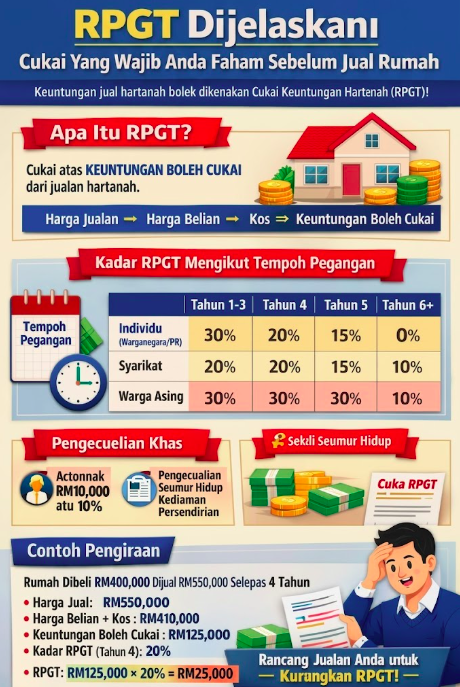
RPGT is levied on the TAXABLE GAIN (chargeable gain) you obtain when selling property, not on the total sale price. A taxable gain is calculated as the sale price (minus disposal costs) minus the original purchase price (plus acquisition costs). It is important to understand this tax early because it can affect your decision when selling, especially if you plan to sell within a few years of purchasing, as the tax rate is much higher for properties held for a short period.
Many believe that RPGT is a "tax for investors" and not relevant to those selling their own homes for relocation. In fact, RPGT applies to ALL property sales that generate a profit, regardless of whether it is an investment property or your own primary residence, although there are specific exemptions for private residences that will be discussed below.
On the other hand, if you sell a property at a loss (selling price is lower than the purchase cost), no RPGT is imposed because no taxable profit is generated. This is important to understand because many people are worried that RPGT will be imposed on every property sale, whereas in fact this tax is specific to profits only, not sales in general.
How RPGT is Calculated: Rates Based on Holding Period and Seller Category
RPGT rates vary according to TWO factors: how long the property is held, and the seller category. The holding period is calculated according to "year bands", and any partial year period is ROUND UP to the next band (for example, holding for 4.5 years is calculated as "year 5").
| Seller Category | Years 1-3 | Year 4 | Year 5 | Years 6 and onwards |
|---|---|---|---|---|
| Individual (citizen/PR) | 30% | 20% | 15% | 0% |
| Company | 30% | 20% | 15% | 10% |
| Foreigner | 30% | 30% | 30% | 10% |
Note that companies remain subject to 10% from year 6 onwards (never drops to 0%), whereas Malaysian citizens/PRs get a rate of 0% after year 6, meaning no RPGT at all after holding the property for more than 5 years. Foreigners are subject to the highest rate of 30% throughout years 1 to 5, much longer than local individuals whose rates start to decrease after the third year.
There are two important exemptions for individuals:
- Automatic individual exemption: the LARGEST amount between RM10,000 or 10% of taxable gain, deducted from the taxable gain before the tax rate is applied.
- Lifetime exemption for private residence: Malaysian citizen/PR is eligible for ONE FULL exemption (making RPGT zero entirely) for disposal of a private residence, but this can only be claimed ONCE in a lifetime, and does not apply to companies or foreigners.
Calculation Example: House Bought for RM400,000, Sold for RM550,000 After 4 Years
Suppose a Malaysian citizen buys a house at RM400,000 with purchase cost RM10,000 (e.g. legal fees and stamp duty at purchase). After 4 years, he sells the house for RM550,000 with disposal cost RM15,000 (e.g. legal fees at sale).
- Net disposal price: RM550,000 - RM15,000 = RM535,000
- Net purchase price: RM400,000 + RM10,000 = RM410,000
- taxable gain: RM535,000 - RM410,000 = RM125,000
- Holding period: 4 years, so year 4 rate applies = 20% (for individual)
- Automatic individual exemption: choose the larger between RM10,000 or 10% x RM125,000 = RM12,500, so exemption = RM12,500
- taxable gain after exemption: RM125,000 - RM12,500 = RM112,500
- RPGT charged: RM112,500 x 20% = RM22,500
If this seller has never used the lifetime exemption for private residence, and this house is indeed their main place of residence, they may be eligible to claim the full exemption, making RPGT potentially RM0 entirely, but this would use up their only lifetime opportunity for such an exemption. Compare this with if this seller waits until year 6 to sell, the RPGT rate will drop to 0% (for individuals), meaning the RM22,500 paid in the example above could be entirely avoided by simply waiting longer, although this needs to be weighed against the risk of market prices changing during that period.
Now compare if the same seller is a COMPANY, not an individual. The company category is not eligible for the automatic RM10,000/10% exemption or the lifetime private residence exemption, so RPGT is calculated directly on the fully taxable profit of RM125,000 at a rate of 20% (year 4) = RM25,000, which is higher than for an individual even though the gross profit is the same. This shows why ownership structure (individual versus company) has a significant impact on the final RPGT amount. For investors who hold property through a company for long-term investment purposes, this rate difference is an important factor to consider alongside a tax advisor before choosing an appropriate ownership structure.
Practical Tips and Common Mistakes
- Keep ALL receipts of purchase and disposal costs. Legal fees, stamp duty, major renovation costs and agent commissions can be counted as costs, reducing your taxable profit.
- Think twice before selling within the first 3 years. The 30% rate is the highest, so if possible, delay a little, as the rate will drop drastically after the third year.
- Plan the use of your lifetime exemption wisely. Since it can only be used once, use it for the property that gives the highest profit, not the first one you happen to sell.
- Understand the rounding of holding period. If you hold for 4 years and 11 months, it is still counted as "year 5" (rounded up), so sometimes waiting an extra month or two can save significant tax.
- Know your seller category accurately. Rates differ greatly between individuals, companies and foreigners, so make sure you calculate using the correct category to ensure your RPGT estimate does not go off track.
- Remember RPGT is only applied on profit, not loss. If you sell at a loss, no RPGT is due because no taxable profit is generated.
- Submit the RPGT form within the stipulated period. After the sale is completed, there is a mandatory period to submit the RPGT-related form to LHDN, so don't delay this matter after the sale is completed.
- Consult your lawyer about retention sum rules. Usually, the buyer's lawyer will withhold a portion of the sale price (retention sum) to ensure RPGT is settled before the remaining amount is paid to the seller, so understand this mechanism to avoid confusion during the sale settlement process.
- Plan your selling period as early as possible. Since RPGT rates change according to the holding period, a little early planning about when to sell can save a significant amount of tax compared to selling in a rush.
RPGT could be one of the biggest costs in your property sale, so plan your selling period and keep cost records meticulously.
Try this calculator for free at Land Gain Tax Calculator.
Note: The figures above are estimates for planning purposes only and not tax advice. Actual rates, exemption conditions and eligibility must be confirmed with the Inland Revenue Board (LHDN).