Many people believe that EPF alone is sufficient for retirement, but the real question that is rarely asked is, sufficient for how long, and at which level of monthly expenses? The Retirement Gap Calculator, built in the style of public retirement calculators offered by Maybank Asset Management, tries to answer this question directly, by comparing what you need versus what you are currently accumulating.
What is a "Retirement Gap" and Why It Is Important to Check
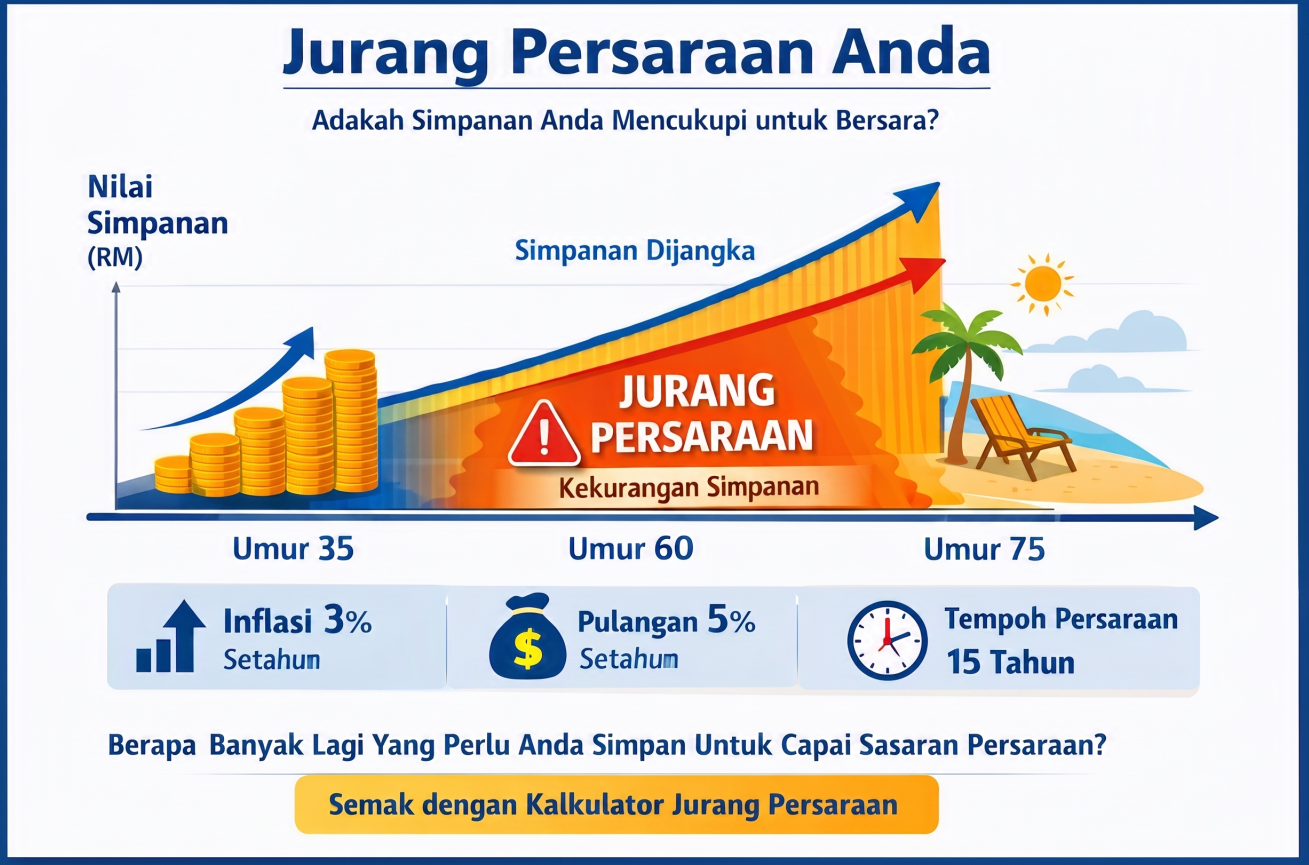
A retirement gap is the difference between the amount of money you need on retirement day, versus the amount of money expected to be available on that day, based on your current savings trajectory. Many people save without clear goals, just "save what you can", without knowing whether that amount is sufficient to support the lifestyle they desire after retiring.
This calculator is more comprehensive than the KWSP calculator alone, because KWSP focuses on only one source of savings, whereas this calculator also takes into account other personal savings and specific monthly expense targets you set yourself.
The design of this calculator follows the style of popular public retirement calculators offered
Maybank Asset Management, which uses a "backwards spending target" approach, starting with the lifestyle you want during retirement, then working backwards to determine how much savings you need today to achieve it. This approach is more meaningful than simply saving without a goal, because it gives you a concrete number to aim for.
How This Gap Is Calculated
This calculation occurs in two separate parts, then compared to each other.
Part one, the required living expenses (required lump sum). You state your desired monthly expenses during retirement, in today's ringgit value. This number is then adjusted forward according to a 3% annual lazy inflation rate, until the year you actually retire, because living expenses will be higher in the future compared to today. This inflation-adjusted monthly expense is then considered as an annuity that needs to support your chosen retirement period (default 15 years), based on an assumption of the investment return rate during retirement (default 5% annually). The result of this calculation is required lump sum, the lump sum amount that must be available on your retirement day to support those expenses throughout your retirement period.
Part two, the expected savings (projected lump sum). This calculator takes into account the current EPF balance, other savings (such as ASB, fixed deposits, or investments), and continuous monthly contributions, then compounds all of them forward until retirement age using the same return rate as above.
Finally, the required corpus is compared with the projected corpus. If the projected corpus is less than what is required, that is the shortfall, and the calculator will recommend the additional monthly savings needed to close the gap by retirement age. If the projected corpus exceeds what is required, that means a surplus, indicating that the current trajectory is sufficient or more than sufficient.
Two default assumptions used in this calculation are important to understand. A 3% annual inflation rate is used to adjust future living costs, as historically inflation tends to erode the purchasing power of money over time. A 5% annual investment return rate is used in both parts of the calculation, whether projecting savings growth before retirement or calculating the annuity needed to cover expenses during the retirement period. Both assumptions can be adjusted according to your risk profile and personal expectations, but these default assumptions provide a reasonable starting point for most planners.
Calculation Example: Age 35, Target RM3,000 Per Month
Say a 35-year-old wants monthly expenses of RM3,000 (in today's ringgit value) during retirement, planning to retire at age 60 (25 years from now), with a retirement period expected to last 15 years. Current EPF balance is RM50,000, other savings are RM10,000, and currently saving RM500 per month.
For the first part, RM3,000 per month today will be adjusted forward over 25 years at an inflation rate of 3% per year, resulting in a much higher monthly expenditure figure by the age of 60, due to the long-term compounding effect of inflation. This adjusted monthly figure is then calculated as an annuity over a 15-year retirement period at a return rate of 5% per year, resulting in a required lump sum figure that is quite large, considering the 25-year projection period ahead.
For the second part, RM50,000 EPF and RM10,000 in other savings (total RM60,000) are compounded at a rate of 5% per year over 25 years, plus a continuous monthly contribution of RM500 that is also compounded. Because the compounding effect over 25 years is quite strong, the projected lump sum amount can increase significantly, but whether it is sufficient to cover the required lump sum depends entirely on the size of the inflation gap compared to the current savings rate. In such a scenario, there is usually a significant gap if the spending target is quite high compared to the RM500 monthly savings rate, and the calculator will recommend the additional monthly amount that needs to be saved to close this gap over the remaining 25 years.
Note how the selection of the retirement period also has a significant impact on the final outcome. If the same person expects a 20-year retirement period instead of 15 years (due to a longer life expectancy or wanting to be more cautious), the required pension fund will increase significantly, as the annuity now needs to cover a longer period. This shows why it is important to choose a realistic retirement period assumption, not just a random number, as it directly determines the size of the gap or surplus shown by the calculator.
Practical Tips for Retirement Planning
- Start with a realistic spending target. Think about the actual lifestyle you want during retirement, not a random number.
- Don't ignore the effects of inflation. RM3,000 today won't be RM3,000 in 25 years, that's why inflation adjustments are important.
- EPF alone is rarely sufficient. Many savers who rely entirely on EPF often find a big gap, because EPF is designed as one of several retirement sources, not the only one.
- Review every few years. Salaries, savings, and retirement lifestyle targets change, so recalculate this gap periodically, not just once in a lifetime.
- Small early additions are more effective than large late additions. Because compounding needs time to take effect, adding to savings earlier is far more powerful than adding a large amount in the final years before retirement.
- Don't rely on just one savings source. A combination of EPF, ASB, fixed savings, and other investments provides more flexibility and reduces risk compared to relying solely on one type of savings.
- Review each time your salary or expenses change significantly. A big salary increase, marriage, or the birth of a child can all change your ability to save and your retirement lifestyle targets, so recalculate this gap periodically.
This calculator is most useful when used together with the KWSP Calculator, as KWSP provides a detailed overview of one main component of your retirement savings (according to the official account structure), while the Retirement Gap Calculator combines this component with other savings and actual spending targets, to provide a comprehensive overview of whether your retirement plan is truly on the right track.
Try this calculator for free at Retirement Gap Calculator.
This projection is an illustrative estimate based on inflation assumptions and return rates set by you or the system, not a guarantee of actual results. It is not licensed investment or financial advice, please consult a certified financial planner for actual retirement planning.