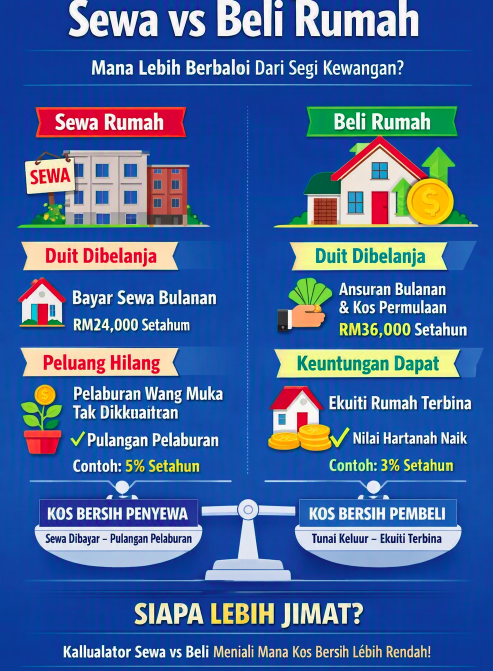
"Renting is wasting money, better buy your own house" is a piece of advice we often hear, but it's not always financially correct. A fair comparison between renting and buying needs to go beyond simply comparing monthly installments with rent, it needs to consider the equity built by the buyer, and the opportunity cost for the renter who doesn't have to pay a large down payment. The Rent vs Buy Calculator on this page is specifically designed to handle these nuances.
Why the Simple "Installment vs Rent" Comparison is Misleading
Many people compare rent vs buy in the simplest way: "monthly installment RM2,300, rent RM2,000, so buying is RM300 more per month, therefore renting is cheaper." This approach is incomplete.
When you buy a house, part of your monthly installment goes towards the loan principal, which gradually builds EQUITY (equity), the net value you own in the property. This is not a "cost" in the true sense, it's more of a forced savings.
On the other hand, a tenant who doesn't need to pay a large deposit and purchase costs (legal fees, stamp duty) actually has extra cash that can be invested elsewhere. If this money is invested and grows at a certain rate of return, this is also a form of "hidden benefit" for the tenant, often overlooked in simple comparisons. This is the nuance of "opportunity cost" that is most often misunderstood: a buyer's house may increase in value, but a tenant's money not spent on a deposit can also grow if invested wisely. A real comparison needs to place both scenarios on an equal footing.
Many people also mistakenly assume that "buying is always better in the long run" as an absolute truth. This is usually true, but not always, especially if the rate of property appreciation in a certain location is slow, or if the alternative investment returns available to the tenant (such as in unit trusts or other instruments) are consistently high. This calculator allows you to test your specific scenario yourself, rather than relying on general assumptions that may not apply to your situation.
How This Calculator Works
For the BUYER, the calculator calculates the total cash outflow over the holding period (down payment, purchase costs such as legal fees and stamp duty, all monthly payments made, plus other monthly costs such as maintenance), then SUBTRACTS the equity built in the home. This equity is calculated as the future value of the property (using a default appreciation rate of 3% per year) MINUS the remaining loan balance that still needs to be paid at that time. So:
- Net Purchase Cost = Cash Outflow - Built Equity
For the TENANT, the calculator calculates the total rent paid over the same period (assuming rent increases each year at the default rate of 3% per year), then SUBTRACTS the investment growth from the money that would have been used for down payment and purchase costs, if that money was invested elsewhere at the default return rate of 5% per year:
- Net Rent Cost = Total Rent Paid - Investment Growth From Unused Money
Any party with a lower net cost at the end of the selected holding period is the option recommended by the calculator purely from a financial perspective (not taking into account non-financial factors such as stability, freedom to renovate the house, or family needs).
These three default assumptions, 3% property appreciation, 3% rent increase, and 5% investment return, can all be adjusted in the calculator according to your personal expectations. If you are confident that a particular area will grow faster than 3% per year, or if you are an investor looking for higher stock market returns than 5%, adjust these numbers to see how the outcomes change. This is the advantage of using a calculator over general rule-of-thumb estimates, you can tailor it to your actual situation.
Comparison Example: RM500,000 Purchase vs RM2,000 Rent, 10 Years
Say you compare buying a unit priced at RM500,000 versus renting a comparable unit at RM2,000 per month, over a holding period of 10 years, using default assumptions (3% annual property appreciation, 3% annual rent increase, 5% annual investment return).
For THE BUYER: over 10 years, the total payments including installments, maintenance costs and initial costs may amount to approximately RM350,000 to RM400,000 (depending on the interest rate and loan structure). The property value with 3% annual appreciation will increase from RM500,000 to an estimated RM670,000 after 10 years. The remaining loan balance to be paid at that time will gradually decrease from the original loan amount. The equity built (future value minus remaining loan balance) is usually a significant figure, often offsetting a large portion of the cash spent during that period.
For THE RENTER: the total rent paid over 10 years (with a 3% annual increase from the base of RM2,000 per month) amounts to an estimated RM275,000 to RM280,000. However, if the down payment and unnecessary purchase costs (estimated RM100,000 to RM120,000) are invested at a 5% annual return over 10 years, it could grow to an estimated RM160,000 to RM195,000, which is a significant investment gain that offsets a large portion of the rent paid.
The final outcome of "which is cheaper" heavily depends on the assumptions used, especially the rate of property appreciation and the rate of return from alternative investments. This is why the calculator allows you to adjust assumptions according to your personal expectations, rather than just blindly accepting default values.
In many scenarios using the default assumptions over a 10-year period, buying tends to show lower net costs compared to renting, especially because the equity built from principal payments and property value appreciation usually exceeds the investment returns that renters could achieve from the unspent cash. However, this gap narrows significantly over shorter holding periods (for example 3 to 5 years), because the initial costs of buying (legal fees, stamp duty) haven't had enough time to be fully "recouped" by the equity built up over such a short period.
Practical Tips When Using This Calculator
- Don't assume that the default assumptions apply to all locations. A 3% annual property appreciation rate is a general estimate; some rapidly developing areas may be higher, while others may stagnate or decline.
- Non-financial factors are still important. Stability for the family, freedom to renovate the house, and the risk of sudden rent increases for tenants—all these are real values not fully captured by numbers alone.
- Test different holding periods. Buying is usually more profitable over longer holding periods (as initial costs are spread over a longer time), so if you might move within 2-3 years, the decision could be very different compared to a 10-year period.
- Ensure that the tenant (if you choose to continue renting) is truly disciplined in investing the money saved. This calculator assumes that the unused cash is consistently invested at a 5% annual return rate. If that money is spent on other things and not invested, the "opportunity cost" advantage for the tenant won't occur in reality.
Try this calculator for free at Rent vs Buy Calculator.
Note: All numbers in this article are illustrative estimates for planning purposes only, not financial or investment advice. Actual appreciation rates, rent increases, and investment returns can vary significantly from the default assumptions, so please adjust according to your own expectations.