Before you start setting up a detailed spreadsheet to calculate the return on investment for a rental property, there is a quick check you can do in just a few seconds: is the expected rent enough to cover the monthly loan instalments? That is the question answered by
Rent Coverage Ratio (RCR) Calculator, a quick check tool before you proceed to more in-depth calculations such as CoCR.
What Is RCR and Why It Is Useful As an Initial Check
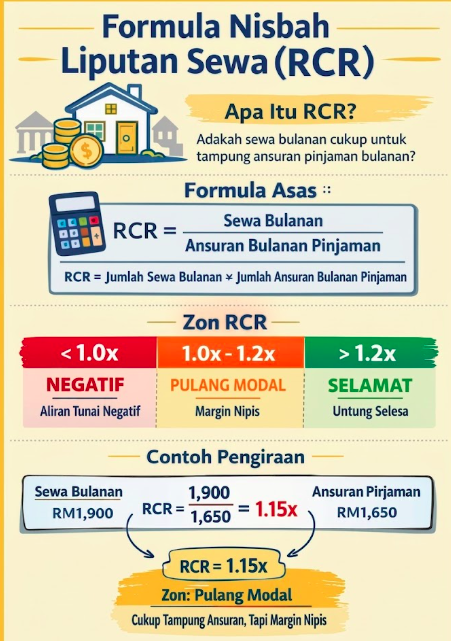
RCR is a simple ratio that compares monthly rent with monthly mortgage instalments, expressed as a multiple (for example "1.15x"). It answers a basic question: "Is my rent enough to pay the bank instalments every month?" If the answer is no, that property is likely to become a monthly financial burden to you, regardless of how attractive other numbers may look.
The advantage of RCR is its simplicity. You don't need to calculate all the small expenses such as maintenance, taxes, or renovation costs to get a rough idea of whether a property is "worth pursuing" or not. This saves a significant amount of time compared to having to go through full calculations for every unit you are interested in before it can be eliminated from the list. Many experienced investors use RCR as a first filter before spending time doing more in-depth CoCR calculations for properties that pass this initial check.
Imagine you are browsing through a property listing on this site and find 20 units that could be for rent. It's impractical to perform full CoCR calculations (which require closing costs, renovation costs, and detailed annual expenses) for all 20 units. With RCR, you only need two figures, estimated rent and estimated loan instalments, to quickly eliminate units that are clearly not worth it, and focus your detailed calculation efforts on the remaining units that are genuinely potential.
Formula and Classification Zones
The formula:
- RCR = Monthly Rent / Monthly Loan Instalment
The result is a multiple, not a percentage. This calculator classifies the result into three zones:
- Below 1.0x, "Negative", rent is not enough to cover loan instalments, meaning you need to add your own money every month just to pay the bank, before even considering any other costs.
- 1.0x to 1.2x, "Break Even", rent is enough to cover loan instalments, but the margin is too thin, and when other costs such as maintenance and property taxes are added, the overall cash flow is likely to be negative.
- Above 1.2x, "Safe Zone", rent provides more than enough room to cover loan instalments, this property is likely to generate positive cash flow even after other costs are considered.
Keep in mind, RCR DOES NOT take into account other costs such as maintenance, taxes, insurance or vacancies, so it is only a rough indicator, not a full return calculation. That is why it is called a "sanity check" review, not a final decision-making tool.
The concept behind these three zones also aligns with the term "gearing" in property investment. Properties in the "Negative" zone are called "negatively geared", meaning the cost of owning the property exceeds the rental income received, a strategy that is sometimes deliberately used by certain investors (for example, for tax benefits in some countries), but is high risk if not carefully planned. The "Safe" zone, on the other hand, is more suitable for investors who prioritise positive cash flow over potential value appreciation alone.
Calculation Example: Rental Unit RM1,900 vs Mortgage Payment RM1,650
Suppose you are evaluating an apartment unit that can be rented out for RM1,900 per month. Based on property price and estimated current loan rates, the monthly mortgage payment for this property is estimated at RM1,650 per month.
RCR = RM1,900 / RM1,650 = 1.15x.
This 1.15x figure falls within the range of 1.0x to 1.2x, which is the "Break Even" zone. This means the rent is sufficient to cover the monthly bank instalments with a small surplus (RM250 per month), but this surplus is likely to be consumed or even turn negative when other costs such as strata maintenance fees, door taxes, land taxes and insurance are also taken into account.
In this situation, the next sensible step is to proceed with a more detailed CoCR calculation, incorporating all actual costs, to get a realistic picture of whether this property is truly profitable in terms of monthly cash flow, or merely "just enough" on paper.
As a comparison, if the monthly installment for the same unit is RM1,700 per month (slightly higher interest rate), the RCR would be RM1,900 / RM1,700 = 1.12x, still within the "Break-even" zone but closer to the lower end. And if the expected rent is only RM1,600 per month, the RCR would drop to RM1,600 / RM1,650 = 0.97x, entering the "Negative" zone, a clear warning sign that the unit is likely to be financially burdensome every month.
Practical Tips and Common Mistakes
- Don't stop at RCR alone. RCR is a quick filter, not an accurate return calculation. Properties with an RCR of 1.3x or higher can still be weak investments if maintenance costs are very high or if you need a large renovation budget.
- Use RCR to quickly screen long lists of properties. If you're comparing 10 to 15 potential units, calculate the RCR for each first to eliminate those clearly in the "Negative" zone before spending time on full calculations for the remaining potential ones.
- The monthly instalments used in RCR should be based on realistic current interest rates, not temporary promotional rates that banks may offer in the first year. Interest rates can rise after the promotional period ends, which will affect your actual RCR later.
- The "Capital Recovery" zone doesn't mean you should avoid it entirely. Some investors are willing to accept low or slightly negative cash flow if they're confident in long-term capital appreciation in the area. However, this is a strategic decision that must be made consciously, not accidentally because you didn't check the numbers from the start.
- Use RCR together with your own Debt Service Ratio (DSR). Even if a property is in the "Safe" zone according to RCR, if its new instalments push your personal DSR beyond the bank's allowed limit, your loan application can still be rejected. Both ratios answer different questions and are equally important.
- Keep a simple list of RCR records for every unit you check. This helps you see patterns more clearly, for example, if most units in an area fall into the "Negative" zone, this could indicate that property prices in that area are too high compared to current rental rates.
- Use RCR to make quick comparisons between different types of properties. For example, a small studio may have a higher RCR than a larger three-bedroom unit in the same building because the price-to-rent ratio usually varies by unit size. This quick check can reveal opportunities you may not have noticed at first.
- Update RCR when bank interest rates change. Since loan monthly instalments are closely related to current interest rates, the RCR of a property you checked six months ago may no longer be accurate now if market interest rates have changed since then.
Try this calculator for free at Rental Coverage Ratio (RCR) Calculator.
Note: All numbers in this article are illustrative estimates for planning purposes only, not financial or investment advice. Please recalculate using the actual property figures you are considering before making a decision.