Every time your salary comes in, a deduction called "PCB" appears on your payslip, but how many people actually know how that number is calculated? PCB, or Monthly Tax Deduction (MTD), is the way the government collects your income tax gradually throughout the year, so you don't have to pay it all at once during tax season. This article explains the mechanism behind the PCB estimate, including the most commonly used tax reliefs.
What Is PCB and Why It Is Important to Understand
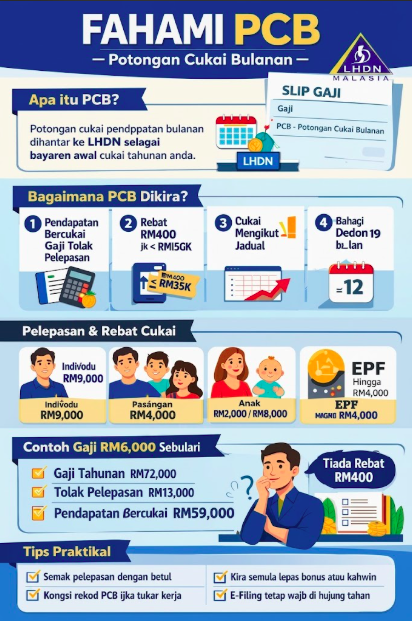
PCB is a monthly deduction that your employer is required to deduct from your salary and send directly to the Inland Revenue Board (LHDN) as an advance payment of your annual income tax. Ideally, the total PCB deducted throughout the year will be close to the actual tax you need to pay, so that when you file your annual tax return (e-Filing), you won't have to pay a large surplus or wait for a large refund. Understanding how PCB is calculated helps you plan your monthly finances more accurately, especially when receiving a bonus, changing jobs, or claiming additional tax reliefs such as children or EPF.
The PCB calculator on this page provides a quick estimate based on the 2025 estimated tax table (YA2025) and the most frequently used standard reliefs, so you can make projections before receiving your actual payslip.
Many employees only realize the importance of understanding PCB when they receive a shock, whether it's a sudden increase in deductions after a pay raise, or a large tax refund during e-Filing. The PCB deducted throughout the year is actually more than the actual requirement. With a clear initial estimate, you can plan your monthly cash flow with more confidence, and not be surprised when your payslip arrives.
How PCB Estimate is Calculated
This calculator calculates the annual taxable income by deducting the eligible tax exemptions from the annual gross salary, then applying the tax rates according to the YA2025 resident tax table to the remainder. The standard exemptions used are:
- Individual exemption: RM9,000, eligible for each taxpayer.
- Spouse exemption: RM4,000, if the spouse is not working or not assessed separately.
- Child exemption: RM2,000 for each "ordinary" child, or RM8,000 for each child studying at a higher education level (diploma, degree, and above).
- EPF exemption: maximum RM4,000, separate and additional to the individual, spouse, and child exemptions above.
After the taxable income is calculated, another important element is the RM400 tax rebate, which is given if the final taxable income is RM35,000 or less. It should be noted that this rebate differs from exemptions, as it directly reduces the amount of tax to be paid, not the taxable income.
This calculator also supports common scenarios where someone changes employers halfway through the year. In such cases, it can allocate the remaining months and take into account the gross salary and PCB already paid by the previous employer, so that the new employer can "catch up" on the correct deductions for the remaining year, rather than deducting too little.
One important thing to understand: this calculator provides an annual adjusted estimate (taxable income annualised and divided evenly across months), not the official cumulative PCB formula from LHDN which considers actual monthly figures sequentially. This means the estimate here is suitable for financial planning, but may differ slightly from the exact figures calculated by your employer's payroll system.
The difference between the annual estimate method and the official cumulative method is important to understand. The LHDN cumulative method considers actual salary, bonuses, and PCB deductions month by month throughout the year sequentially, so if there is a change in salary or bonus in a particular month, it will automatically adjust the PCB deductions for the following months. This calculator, on the other hand, takes a simpler approach, assuming the annual taxable income and dividing it evenly across 12 months, suitable for initial planning, but does not replace the more dynamic actual payroll calculation.
Calculation Example: RM6,000 Monthly Salary
Suppose a single employee, no children, gross salary RM6,000 per month (RM72,000 per year), claims full EPF release of RM4,000, and has no other releases.
Step 1, calculate taxable income: Annual salary RM72,000, deduct individual exemption RM9,000, deduct EPF exemption RM4,000. Taxable income = RM72,000 - RM9,000 - RM4,000 = RM59,000.
Step 2, check eligibility for RM400 rebate: Since taxable income RM59,000 exceeds RM35,000, the RM400 rebate is not eligible in this case.
Step 3, calculate tax according to the YA2025 resident tax band schedule on RM59,000, that is, the annual tax amount will be calculated progressively according to the relevant income band.
Step 4, divide the annual tax by 12 months to get the estimated monthly PCB deduction from the salary. This figure will appear on the payslip as the monthly PCB deduction, and it will differ slightly from the actual payroll calculation due to the difference in annual estimation methods compared to cumulative methods as explained above.
Now compare with the scenario if the same employee is married and the spouse does not work. With the additional spouse exemption of RM4,000, taxable income will decrease to RM55,000 (RM59,000 minus RM4,000), slightly reducing the annual tax amount and thus the estimated monthly PCB. If the spouse also has a child studying at a higher education level, an additional RM8,000 exemption will further reduce taxable income to RM47,000, still above the RM35,000 threshold for the rebate, but it shows how each additional exemption directly affects the monthly PCB estimate of an individual.
Practical Tips and Common Mistakes
- Claim your EPF and child release accurately. Many employees miss stating the correct number of children to their employer, causing the PCB to over-deduct throughout the year.
- Don't panic if the payroll figure is slightly different. Since this calculator uses an annual estimation method, not month-by-month cumulative, slight differences with the actual payslip are normal.
- Changed employer? Provide your old PCB statement. If you change jobs halfway through the year, provide your old salary and PCB statement to your new employer so that the remaining tax deduction for that year is accurate and not reduced.
- The RM400 rebate is not for everyone. It only applies if your taxable income, after all releases, is RM35,000 or less.
- PCB is not final tax. It is only an initial deduction; actual tax still needs to be settled through annual e-Filing, where any overpayment will be refunded or any shortfall needs to be paid.
- Recheck after any major changes. Salary increases, large bonuses, marriage, or the birth of a child all change your PCB estimate, so recalculate every time there is such a change.
- Use this calculator for planning, not for filling out tax forms. It is suitable as a monthly planning guide, but the annual tax form still needs to be filled using the official figures from your employer's EA statement.
- Keep receipts and release documents throughout the year. Additional releases such as medical, education, or OKU support devices (not discussed in detail here) can also reduce your taxable income during e-Filing, so keep relevant documents from the start of the year.
- Avoid mistakenly considering PCB as "additional tax". PCB is not a separate tax from annual income tax; it is just an instalment payment method for the same tax, so the amount deducted throughout the year will be adjusted during the actual annual tax calculation.
Try this calculator for free at PCB Calculator.
This calculator provides only illustrative estimates based on the YA2025 tax table and is not an official LHDN calculation. It is not tax advice, please verify the actual figures with your employer's payroll department or LHDN.