Every month, the figure shown in your job offer letter (basic salary) never matches the actual amount that enters your bank account. Between these two figures, there are several statutory deductions that must be subtracted, such as EPF, SOCSO, EIS, and monthly tax (PCB). Many employees know these deductions exist, but rarely understand how they are calculated, which is why payslips sometimes feel like a "mystery." This article breaks down each of these deductions one by one, so you can estimate your net salary yourself before accepting a job offer or signing a new contract.
What Is Net Salary and Why It Matters
Net salary (or take-home pay) is the actual amount of money that enters your bank account after all statutory deductions have been subtracted from your gross salary. It differs from gross salary, which is the total amount before any deductions, usually stated in the job offer or employment contract. For most employees, the difference between gross and net salary can reach ten to twenty percent, depending on your salary level and tax status. This is why it is important to plan your expenses based on your net salary, not your gross salary, as incorrect estimates can cause monthly cash flow problems.
The Net Salary Calculator at Hartanah Bumiputera combines all these deductions in one place, so you don't have to calculate each component separately. This is extremely useful when evaluating a new job offer, planning your monthly budget, or simply wanting to understand where your salary goes every month.
It is also very useful when comparing two job offers that appear almost the same on the surface. Two companies may offer the same basic salary of RM5,500, but if one company calculates the salary based on different employee ages or different allowance structures, the final net salary that enters the bank account can differ by tens of ringgit per month. Without calculating each of these components separately, it is difficult to make a fair comparison between job offers.
The Actual Formula Behind Each Deduction
There are four main components deducted from the gross salary before it becomes the net salary. Here are the actual rates used:
EPF/KWSP. For employees under 60 years old, the employee contribution is 11% of the salary, while the employer contribution is 13% for salaries up to RM5,000 per month, or 12% for salaries exceeding RM5,000 per month. For employees aged 60 and above, the employee contribution is reduced to 5.5%, while the employer contribution is 4% for salaries up to RM5,000, or 6.5% for salaries exceeding RM5,000. Starting at the age of 75, EPF contributions become entirely voluntary, with no mandatory deductions.
SOCSO (PERKESO). SOCSO contributions are calculated based on a monthly salary ceiling of RM6,000, meaning that any salary exceeding RM6,000 is still calculated as RM6,000 for contribution purposes. Under Category One (Employee Accident Scheme and Occupational Injury Scheme), the employee contribution rate is 0.5%, while the employer contribution rate is 1.75%.
EIS (Employment Insurance Scheme). EIS applies to employees up to the age of 60, with a contribution rate of 0.2% from the employee and 0.2% from the employer.
PCB (Monthly Tax Deduction). After EPF, SOCSO and EIS are deducted, monthly income tax (PCB) is calculated on the remaining salary, based on the current tax table and eligible tax exemptions. The full mechanism of PCB is quite detailed, so it is explained separately in the PCB Calculator article on this site. What is important to remember here is that PCB is calculated after EPF is deducted (because EPF contributions are also eligible as tax exemptions), not before.
It is also important to note that EPF, SOCSO and EIS contributions are not one-sided deductions; the employer also contributes their own share on the employee's salary, separately from what is deducted from the employee's salary. These employer contributions do not reduce the employee's net salary, but they add to the employee's EPF savings and the SOCSO/EIS protection enjoyed, so the actual "total compensation" of an employee is actually higher than just the net salary that enters the bank account every month.
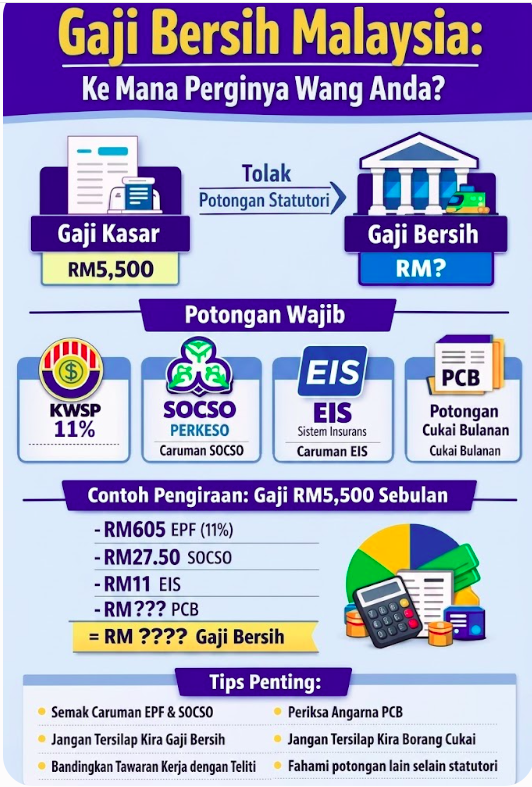
Example Calculation: RM5,500 Monthly Salary
Let's say a single employee under the age of 60 receives a gross salary of RM5,500 per month. Let's calculate the statutory deductions step by step.
Employee's EPF: 11% x RM5,500 = RM605. This is deducted directly from the gross salary.
Employee's SOCSO: Since RM5,500 is still below the RM6,000 ceiling, the contribution is calculated on the actual RM5,500. At a rate of 0.5%, this is equivalent to RM27.50 (the actual figure in the official SOCSO table may differ slightly because it uses a graded table, but the 0.5% rate provides a reasonable estimate).
EIS employee: 0.2% x RM5,500 = RM11.
Total deductions for EPF, SOCSO, and EIS employee: RM605 + RM27.50 + RM11 = RM643.50. This means that even before PCB is deducted, the gross salary of RM5,500 has already been reduced to approximately RM4,856.50.
From this remaining amount, PCB is then calculated and deducted (using individual exemptions, EPF exemptions, and the current tax table), to arrive at the actual net salary that finally enters the bank account.
On the employer's side, since the salary of RM5,500 exceeds the RM5,000 threshold, the applicable employer EPF contribution rate is 12% (not 13%), which is RM660. The employer also covers SOCSO contributions at a rate of 1.75%, and EIS at a rate of 0.2%, both calculated on the RM5,500 salary (as it is still below the RM6,000 ceiling). The total employer contributions are not deducted from the employee's salary, but they represent the actual cost the employer bears to pay someone at that salary level, something useful to understand if you are negotiating a salary or evaluating the compensation structure of a job offer.
After EPF, SOCSO, and EIS employee deductions are subtracted from RM5,500, the remaining RM4,856.50 becomes the basis for calculating PCB. Since this employee is single and can claim individual exemptions and EPF exemptions up to RM4,000, the taxable income after exemptions usually falls within a range subject to a relatively low marginal tax rate, resulting in a monthly PCB deduction that is not too large compared to the earlier deductions of EPF, SOCSO, and EIS. The actual PCB amount depends on the full tax table, so for a more accurate estimate, please refer to the separate PCB calculator on this page.
Tips To Avoid Being Surprised By Your Pay Slip
- Check your age status. The EPF rate and EIS eligibility vary according to age groups, so make sure your employer uses the correct rate for your age.
- Don't forget the SOCSO ceiling. If your salary exceeds RM6,000, your SOCSO contribution will not continue to increase with your salary, as it is capped at RM6,000.
- Understand why PCB changes every year. Bonuses, irregular allowances, or changes in marital status can suddenly change your monthly PCB estimate.
- Use net salary for budgeting, not gross salary. Many people mistakenly plan home or car installments based on gross salary, while banks also assess repayment ability based on net income.
- Carefully compare job offers. Two offers with the same gross salary can result in different net salaries if age, EPF status, or allowance structure differs.
- The difference between fixed and irregular allowances is important. Some allowances are counted as salary for EPF and SOCSO purposes, while others are not, so the salary package structure can affect the actual deductions.
- Save a copy of your payslip every month. This makes it easier for you to track any discrepancies between actual deductions and estimates, and is useful when filling out your annual tax form.
This calculator simplifies the process by combining all the components at once, so you can get a full overview in just a few seconds, without needing to open separate calculators for each component. This is especially useful for those new to the working world, or those looking to plan a career change with more confidence, as a clear picture of your net salary helps make more accurate financial decisions, whether it's for applying for a housing loan, planning monthly expenses, or simply assessing whether a new job offer is really worth it compared to your current job.
Try this calculator for free at Net Salary Calculator.
Note: This calculator provides illustrative estimates based on current statutory rates, and is not official tax or financial advice. Please verify the actual figures with your human resources department or employer's payroll, or refer to LHDN and KWSP for the latest official information.