When a bank approves a home loan, one thing that is rarely explained clearly is the choice between MRTA and MLTA, the insurance or takaful that protects the remaining balance of your home loan in case of death or permanent disability. Many borrowers just sign without understanding the real difference between the two, whereas this difference can affect how much you pay and how flexible the protection will be later. Our MRTA vs MLTA calculator helps you see the comparison in numbers before making a decision.
What is the difference between MRTA and MLTA, and why is it important
MRTA (Mortgage Reducing Term Assurance) is insurance/takaful where the amount of coverage (sum assured) DECREASES over time, according to the decreasing balance of your home loan. Usually, the premium is paid once as a lump sum, and usually this amount is directly paid into the home loan itself so that you don't have to pay cash separately. Generally, MRTA is the cheaper option. However, there is one important weakness:
MRTA CANNOT be transferred. If you sell the house or refinance with another bank, the old MRTA policy cannot be taken along, you need to apply for a new policy from scratch.
MLTA (Mortgage Level Term Assurance), on the other hand, the amount of coverage remains THE SAME LEVEL throughout the loan period, or can be structured higher than the loan balance. This is usually more expensive than MRTA, but offers more flexibility, for example, some MLTA plans can be transferred (assigned) to another loan or property, and some plans also build cash value over time.
Why is this important? Because this choice is not just about monthly costs, it's about how many family members you are protecting, and whether that protection remains relevant if your life changes, for example, if you sell your house and buy a new one within the next 10 years.
Another thing to understand: both MRTA and MLTA actually have the same objective, which is to ensure that the remaining balance of your home loan is paid off (or a large portion of it) if you pass away or become permanently disabled before the loan is completed, so that your heirs do not inherit your home debt. The difference is only in terms of the STRUCTURE of the protection and COST, not the basic purpose. For Muslim buyers, a takaful version of both products is also available (usually called MRTT and MLTT), operating on the principle of risk sharing according to Shariah, but the mechanism of decreasing vs. level coverage still applies.
How the premium estimation calculator works
The illustrative premium estimate in this calculator takes into account three main factors:
- Loan amount: The larger the loan amount, the more coverage needed, so the higher the premium.
- Borrower's age: Older borrowers pay higher premiums, because mortality risk (risk of death or health issues) increases with age.
- Loan term (tenure): A longer loan term means a longer protection period as well, so the premium becomes higher compared to a shorter term.
This calculator applies this logic separately for MRTA and MLTA so that you can see the difference in estimated costs between the two based on your own loan profile. But remember, this is
ROUGH ESTIMATE only. The actual premium depends largely on the insurance company you choose, the underwriting decision after you fill out the medical inquiry form, and the structure of the total coverage selected (whether it follows the full outstanding loan balance or less). Always get the actual quote from your bank or takaful/insurance provider before making a final decision.
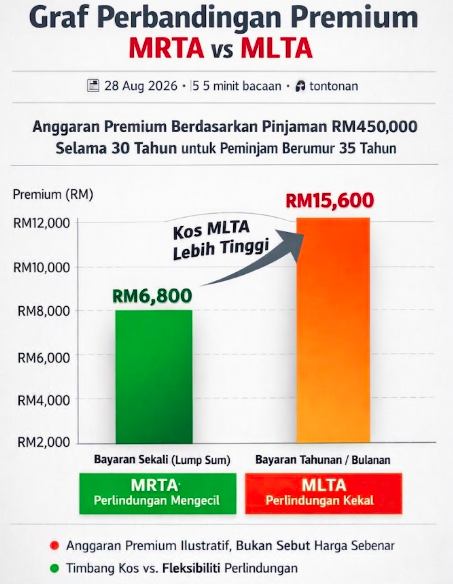
Example: 35-year-old borrower with a RM450,000 loan over 30 years
Let's take an example of a 35-year-old borrower who takes out a RM450,000 home loan over a 30-year period. When entered into the calculator, the system will generate two separate estimates:
- Estimated MRTA premium, usually paid once as a lump-sum (or financed into the loan), based on a loan amount of RM450,000, age 35, and a 30-year term.
- Estimated MLTA premium for equivalent coverage, based on the same inputs.
The MLTA premium will be higher than the MRTA, which is consistent with the nature of the MLTA that maintains full coverage throughout the term, compared to the MRTA which decreases as the loan balance decreases. This cost difference needs to be weighed against the tradeoff: MRTA is cheaper but coverage decreases with the loan balance and cannot be transferred if the house is sold or refinanced; MLTA is more expensive but remains flexible, can be transferred in some cases, and is suitable for borrowers who plan to sell property or refinance in the future.
For a 35-year-old borrower in this example, if they plan to stay with the same house and loan for 30 years, MRTA might be more cost-effective. However, if they expect to upgrade their home or refinance within 5 to 10 years, the additional cost of MLTA might be worth it due to its transferability flexibility.
There is also an age factor to consider in this example. If the same borrower is 45 years old (not 35) with the same loan amount and term, both MRTA and MLTA estimates will increase due to higher mortality risk at an older age. However, the increase in MLTA is likely to be more significant compared to MRTA, because MLTA maintains full coverage throughout the term, thus the insurance provider bears higher overall risk costs compared to MRTA whose coverage decreases as the loan balance decreases.
This leads to a useful general principle when you calculate on your own: the younger you are and the shorter your loan term, the smaller the premium gap between MRTA and MLTA, because the overall risk borne by both products is lower. Conversely, older borrowers with longer loan terms will notice a more pronounced cost gap between these two options, making the decision between MRTA and MLTA more significant in terms of long-term financial impact.
Practical tips and common mistakes
- Don't choose just because it's "cheaper". MRTA may look cheaper, but if you plan to sell your house in the near future, the cost of applying for a new policy afterwards could erase your initial savings.
- Understand decreasing vs level coverage. With MRTA, if you pass away in the 25th year of a 30-year term, the coverage paid will be much lower compared to the first year. With MLTA, coverage usually remains higher.
- Check if the premium is financed through a loan. If the MRTA premium is financed through a home loan, this means you'll also pay interest/profit on that premium throughout the loan period, so calculate the actual long-term cost carefully.
- Fill out the health form honestly. The actual premium will change based on underwriting decisions, and hiding health information can cause claims to be rejected later.
- Compare quotes from more than one provider. Premiums can vary significantly between insurance and takaful, and between different companies for the same coverage structure.
- Consider a joint loan. If you and your spouse apply for a joint home loan, some MRTA/MLTA policies can be structured to protect both borrowers, check with the provider whether the coverage is for one person only or both.
- This coverage is separate from fire insurance. Don't confuse MRTA/MLTA (protects the remaining loan balance if the borrower dies or becomes disabled) with fire insurance (protects the structure of the house from physical damage), they are completely separate policies with different purposes.
Try this calculator for free at MRTA vs MLTA Calculator.
Warning: The numbers shown by this calculator are illustrative estimates for initial comparison purposes only, not official offers. The actual premium will be determined by your chosen insurance/takaful after the full assessment process, so please refer to the bank or provider for accurate information.