For public servants intending to purchase their first home, LPPSA is often the best financing option available, sometimes even more attractive than conventional bank loans. However, before heading to the application counter, it is important to know whether you are truly eligible, as LPPSA sets three separate eligibility criteria that must all be met simultaneously. The LPPSA Eligibility and Installment Calculator helps you check these first, before wasting time applying.
What Is LPPSA and Why It Is Special
LPPSA, or the Public Sector Housing Finance Board, is a housing financing scheme specifically for eligible public servants. It becomes so attractive for two main reasons, very high financing margins, which can reach up to 100% of the house price or the official valuation by the Department of Valuation and Property Services (JPPH), whichever is lower, and competitive profit rates (the term "profit" is used because LPPSA is based on Islamic financial concepts, not "interest"), with an illustrative default rate of 4.0% per year. These advantages are not available to private sector workers, as this scheme is specifically designed for public servants only, as one of the benefits of public service.
For first-time homebuyers, especially young people who have just started working in the public sector, a financing margin of up to 100% is very significant, as it reduces or eliminates entirely the need for a large down payment, a major obstacle that often prevents first-time homebuyers from owning their own home through conventional bank financing, which usually requires a lower margin.
Net Income Formula and Three Eligibility Limits
The first step in determining LPPSA eligibility is to calculate net income, which is gross income (basic salary plus fixed allowance) minus mandatory statutory deductions. This net income figure is the basis for two of the three eligibility limits below.
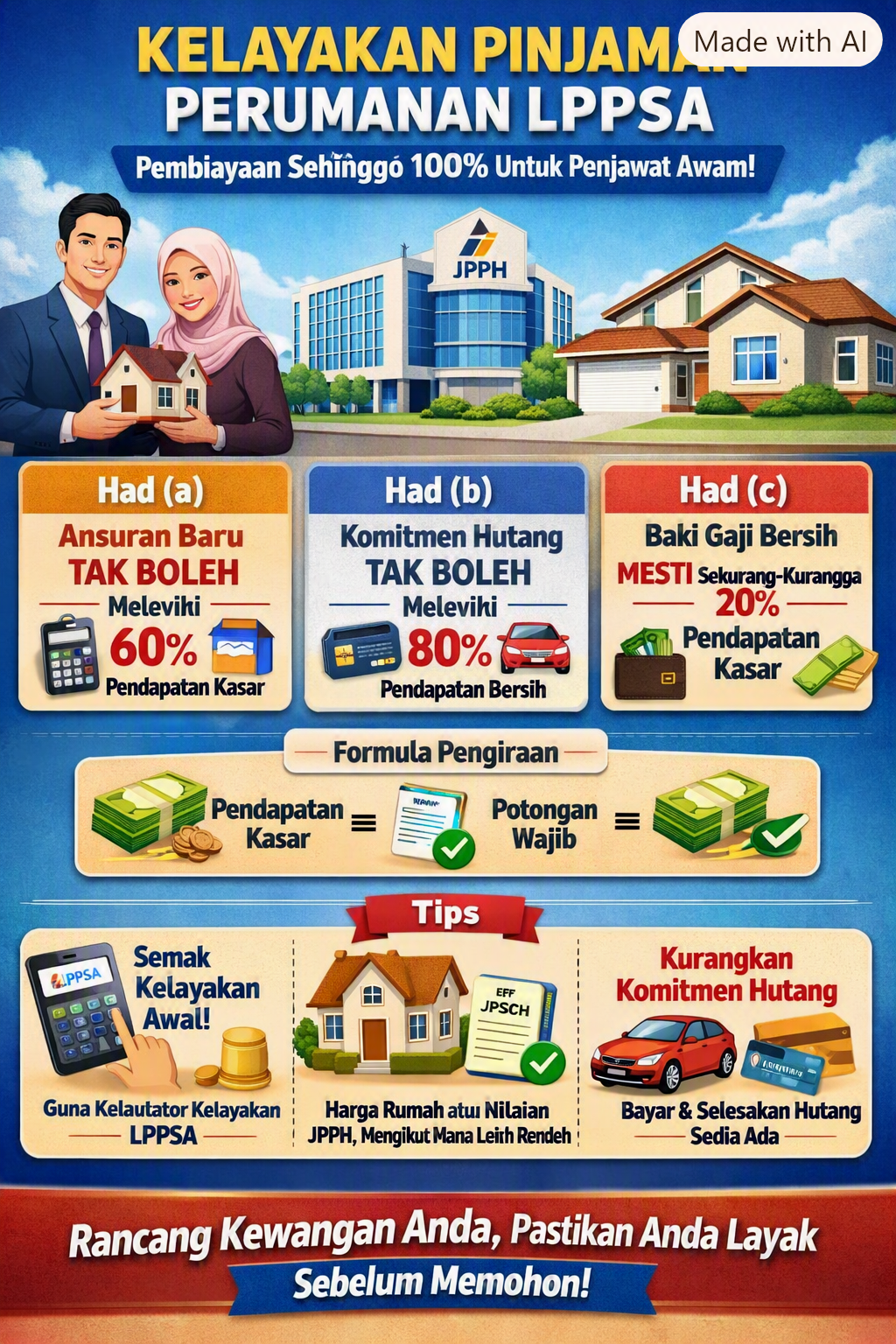
For full eligibility, the LPPSA application must meet all three of the following limits simultaneously:
- Limit (a): the new monthly installment cannot exceed 60% of gross income.
- Limit (b): the total monthly debt commitment, including this new installment, cannot exceed 80% of net income.
- Limit (c): the net salary remaining after ALL deductions, including this new installment, must remain at least 20% of gross income.
The financing margin is limited to 100% of the house price, or the official valuation by JPPH, whichever is lower. This is important because if the official valuation is found to be lower than the actual selling price, the approved financing amount will be based on the lower valuation, not the selling price. The maximum financing period depends on the applicant's age, the younger the applicant, the longer the potential financing period that can be approved.
All three eligibility thresholds exist for the same purpose, ensuring that public servants approved for financing are truly able to manage monthly installments without affecting their basic living needs. Threshold (a) ensures that installments do not excessively burden gross salary, threshold (b) ensures that the total debt (including car loans, credit cards, and other commitments) does not exceed actual capacity based on net income, while threshold (c) acts as a final safety net, ensuring that after all deductions and installments, there is still a sufficient balance for daily expenses such as food, transportation, and family needs.
Calculation Example: Public Servant Age 28, Buying a House RM350,000
Suppose a public servant aged 28 years, basic salary RM3,800, fixed allowance RM400 (total gross income RM4,200 per month), intends to buy a house priced at RM350,000, with the JPPH valuation confirmed to match the selling price.
Step 1, estimate net income. From the gross income of RM4,200, deduct mandatory statutory deductions (such as EPF and other related deductions) to obtain an estimated monthly net income. This net figure will be the basis for threshold (b) above.
Step 2, check threshold (a). The new monthly installment for a RM350,000 housing loan at a profit rate of 4.0% must not exceed 60% of RM4,200, that is, the installment must remain below RM2,520 per month.
Step 3, check limit (b). The total of all monthly debt commitments, including this new home installment, must not exceed 80% of the net income calculated in Step 1. If the applicant has no other debt commitments (such as car loans or credit cards), this limit is usually easier to meet compared to applicants with existing commitments.
Step 4, check limit (c). After deducting all deductions including the new home installment, the remaining net salary must stay at least 20% of RM4,200, which is at least RM840 per month must remain for the applicant's daily expenses.
If all three limits are met simultaneously, and a 100% financing margin from RM350,000 (equivalent to the JPPH valuation) is approved, this 28-year-old applicant has the potential to get a long financing period, considering the young age of the applicant provides more room for the maximum period allowed by LPPSA.
Note also the importance of the calculation order here. Limit (a) only involves the installment compared to gross income, so it can be checked quickly as soon as the financing amount and profit rate are known. Limits (b) and (c) require calculating net income first, and also take into account any existing debt commitments of the applicant, such as car loans or credit cards, which if present, will significantly narrow the eligibility space for limit (b) compared to applicants with no other debt commitments.
Tips Before Applying for LPPSA
- Calculate all three limits before applying. Do not assume eligibility just because your salary is sufficient; all three criteria must be met simultaneously, not just one.
- Reduce existing debt commitments if possible. Existing car loans or credit card debt can significantly affect limit (b).
- Ensure the JPPH valuation is confirmed early. If the official valuation is lower than the selling price, the financing margin will be based on the lower valuation, not the actual house price.
- Understand the maximum term according to age. Younger applicants are usually eligible for longer financing terms, which means lower monthly installments.
- Compare with bank financing if both are eligible. Although LPPSA is often more attractive for public servants, it is still worth checking and comparing the actual terms before making a final decision.
- Prepare supporting documents earlier. Salary statements, KWSP statements, and job verification documents are usually required during the application process; prepare all of these in advance to streamline the process.
- Understand the difference between financing margins and market prices. If you plan to buy a resale house (not new from a developer), the JPPH valuation may differ significantly from the agreed price with the seller, so obtain an initial valuation before proceeding with an offer.
Why This Is Important For Public Servant Financial Planning
Many young public servants rush to apply for housing financing as soon as they show interest in a property, without first checking themselves whether they meet all three eligibility criteria. As a result, some applications are rejected or approved with a lower financing amount than expected, causing disappointment and delays in the home buying process. By checking yourself using this calculator first, you can determine whether you are truly eligible, or need to reduce existing debt commitments first, or consider a lower house price, before investing time and effort in the longer official application process.
Try this calculator for free at LPPSA Calculator.
This calculator provides illustrative estimates based on profit rates and general eligibility criteria, not official approval decisions. Please verify your actual eligibility and required documents directly with LPPSA before making any home buying decisions.