Nearly every Malaysian worker has a KWSP account, but how many really know how large their savings will grow by retirement age? Most people only check their current balance in the i-Account app without making any forward projections. The KWSP Contribution Calculator on this page tries to bridge that gap, by projecting your savings year by year, up to your chosen retirement age.
What This Calculator Does and Why It Is Useful
Most people consider EPF as a single balance, whereas since the account structure update in 2024, KWSP savings are now split into three separate accounts, each with a different purpose. Without a clear projection, it is hard to know whether current savings are sufficient for retirement, or whether additional contributions through voluntary contributions are needed. This calculator projects savings growth year by year using actual historical dividend data, not arbitrary assumptions, so that projections are closer to reality than rough estimates.
A common question among many workers is, "if I continue contributing as I do now, will it be enough for me to retire comfortably?" Without a projection, this question is hard to answer, as the compounding effect of annual dividends over decades is hard to imagine just by looking at the current balance. This calculator tries to answer this question concretely, year by year, up to your chosen retirement age, complete with checks against official KWSP benchmarks.
Account Structure and Rates Used
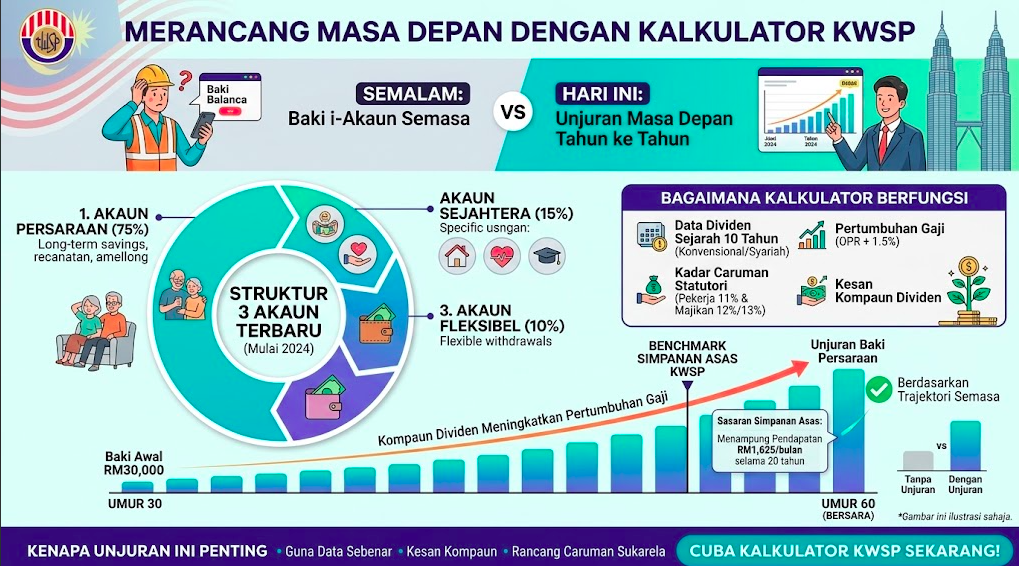
Since the 2024 update, each monthly KWSP contribution is automatically split into three accounts:
- Retirement Account (Account 1): receives 75% of the total contribution, for long-term retirement savings.
- Wellbeing Account (Account 2): receives 15% of the contribution, can be used for specific purposes such as housing or health according to the stipulated conditions.
- Flexi Account (Account 3): a new account that receives 10% of the contribution, designed for more flexible withdrawals according to current needs.
The monthly contribution rate that drives these three accounts uses the same statutory rate as explained in the Net Salary Calculator article: 11% (employee) and 13% or 12% (employer, depending on whether the salary is below or exceeds RM5,000) for employees under 60 years old, 5.5% (employee) and 4% or 6.5% (employer) for employees aged 60 and above, and 0% mandatory from the age of 75 and above (contributions after that become entirely voluntary).
Two main assumptions drive this long-term projection. Salary growth rate, if not manually specified, will default to the Overnight Policy Rate (OPR) currently set by Bank Negara Malaysia plus 1.5 percentage points. Dividend rate, if not manually specified, will default to the average historical dividend rate of KWSP over the past 10 years, calculated separately according to the Conventional Scheme or Shariah Scheme, based on officially announced EPF historical dividend data.
This calculator also checks the final projection against the official KWSP benchmark, namely Basic Savings at the age of 60, a target designed to support a monthly income of RM1,625 for 20 years of retirement. It will show whether your projected balance at the age of 60 meets, or falls short of, this target.
Both assumptions can be adjusted manually if you want a more conservative or more optimistic scenario. For example, a cautious person may want to use a lower dividend rate than the 10-year historical average, to see whether their retirement plan remains solid even in a less encouraging scenario. This flexibility is important because no one can guarantee that future dividend rates or salary growth will exactly match the historical average.
Projection Example: Starting at Age 30, Retiring at Age 60
Suppose a 30-year-old worker with a salary of RM5,000 per month, with an existing balance of RM20,000 in Account 1, RM8,000 in Account 2, and RM2,000 in Account 3. He plans to retire at the age of 60, that is, a 30-year projection, using the default assumptions of salary growth rate based on the current OPR plus 1.5 percentage points, and dividend rate based on the 10-year historical average.
Each year, the calculator will add new contributions (employee and employer at a rate of 11%/13% for a RM5,000 salary, remember the employer rate is 13% because a salary exactly at RM5,000 is still in the "up to RM5,000" category), split according to the 75%/15%/10% ratio into the three accounts, and then apply annual dividends to the total balance.
Due to the expected increase in salary each year according to growth assumptions, the total ringgit contribution also increases year by year, not remaining static at RM5,000. Over the 30-year period, the compounding effect of annual dividends becomes the largest contributor to the growth of the balance, greater than the principal contributions in subsequent years. At the end of the projection period, the calculator will compare the combined balance of Account 1 and 2 (usually the main reference for the Basic Savings target) with the official target, indicating whether the current trajectory is on a sufficient path, or requires additional voluntary contributions to meet the target.
Throughout this 30-year period, Account 3 (Flexible Account) also grows at a rate of 10% of each contribution, providing a separate savings that can be accessed more flexibly according to current needs, without affecting the integrity of the core savings in Account 1 and Account 2 which are dedicated for long-term retirement purposes. This means that even though the total savings appear large at the end of the projection period, it is important to understand that not all parts of it are available for the same purpose, some for core retirement, some for short to medium-term flexibility.
Why This Projection Is Important For Your Planning
- Most people never make this projection on their own. The current balance in your i-Account does not tell you where it will go in 20 or 30 years' time.
- Use actual historical dividend data, not guesses. This provides a more reasonable estimate compared to arbitrary growth assumptions.
- Check the Shariah Scheme separately from the Conventional Scheme. The dividend history of both schemes differs, so make sure you choose the correct scheme according to your actual account.
- Historical dividends are not a guarantee of the future. EPF announces dividends each year based on actual investment performance, so this projection is an estimate, not a promise.
- If the projection falls short of the Basic Savings, consider voluntary contributions. Adding contributions early, even small ones, makes a big difference due to long-term compounding.
- The salary projection also takes into account career growth. The default salary growth rate based on OPR plus 1.5 percentage points provides a reasonable estimate, but if you expect faster or slower salary increases than average, adjust this number manually for a more relevant projection based on your personal situation.
- Don't wait until it's too late to start checking. The earlier you check this projection, the more time you have to make adjustments, whether by increasing voluntary contributions or adjusting your retirement lifestyle goals.
Moreover, it is important to note that this projection does not take into account any withdrawals from Account 2 or Account 3 during the projection period, such as withdrawals for housing, education, or emergencies. If you plan to make such withdrawals in the future, the actual balance at retirement age may be lower than the original projection, so take this factor into consideration when making your long-term planning.
Try this calculator for free at KWSP Calculator.
This projection is an illustrative estimate based on assumptions about dividend rates and salary growth, not a guarantee of actual returns. It is not financial advice, please refer to KWSP officially for your accurate account balance and information.