Most home loan borrowers only pay monthly installments as set by the bank, without realizing that adding even a small amount to those payments every month can shorten the loan term by several years and save tens of thousands of ringgit in interest. The Interest Savings Calculator on HartanahBumiputera is designed to clearly show the actual impact of additional fixed payments on your home loan, compared to the regular payment schedule.
What Is Measured and Why It Matters
This calculator compares two scenarios: the regular amortization schedule (payments as per your loan agreement), compared to a scenario where you pay a fixed additional amount every month, on top of the regular installment, and this additional amount is directly applied to reduce the principal balance of the loan. The results are shown in two main figures: how many months earlier your loan will be completed, and how much interest you will successfully save over the loan period.
This is important because home loans typically run for 20 to 35 years, and over that period, the total interest paid can equal or exceed the price of the house itself. Any effort to reduce the principal balance earlier will have a significant impact on the total interest that needs to be paid, even if the additional monthly amount seems small at first.
Many home loan borrowers are unaware that they actually have a lot of control over the total amount of interest they will pay throughout the life of the loan, not just accepting the schedule set by the bank on the first day. By adjusting the additional monthly payments according to current financial capacity, an individual can actively shorten the period of debt bondage, while continuing to live in the same house without needing to make any major changes to the original loan agreement.
The Actual Mechanism Behind This Savings
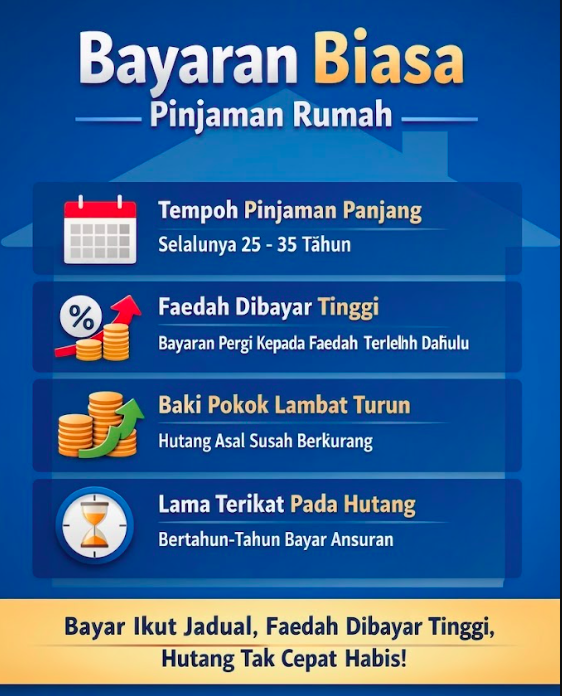
Home loans are calculated using an amortization system, where each monthly payment is split into two parts: the interest for that month (calculated on the current principal balance) and the payment towards the principal balance. In the early years of the loan, most of your monthly installments actually go towards interest, and only a small portion truly reduces the principal balance.
When you make additional payments that are directly applied to the principal balance, that balance is reduced earlier than in the original schedule. Since future monthly interest is calculated on this lower balance, the amount of interest charged each subsequent month also decreases, continuously throughout the remaining loan period. This is why additional payments made in the early stages of the loan have a much greater saving effect compared to the same amount of additional payments made in the later years of the loan, because the effect of reducing the principal is "compounded" over the remaining long period of the loan.
This also means that two borrowers who pay the same additional monthly amount, but start at different loan stages, will achieve very different savings results. One who starts paying additional amounts from the first month will save much more compared to someone who only starts in the 15th year of a 20-year loan.
Some also believe that additional payments are only useful for high-income borrowers, but in reality, anyone who can set aside even RM100 or RM200 extra every month can see meaningful effects in the long term, especially if it is started early and continued consistently throughout the loan period, without needing to stop or reduce it at any time.
Some borrowers choose to increase their additional payment amounts every time they receive a salary increase, so that their lifestyle does not automatically increase alongside their income, but instead, the extra income is directed straight towards accelerating freedom from housing loan debt. This strategy, when combined with an early start, can have a very significant impact on the total interest that needs to be paid throughout the life of the loan, while your daily lifestyle remains unaffected.
Calculation Example: RM400,000 Loan Over 30 Years
Say you take a home loan of RM400,000 at an interest rate of 4.0% per year, over a period of 30 years. Under a standard schedule, you will pay a fixed monthly instalment for 360 months, with the total interest paid over the period amounting to tens of thousands to hundreds of thousands of ringgit, depending on the structure of the rate throughout the period.
Now, imagine you add an extra RM300 every month to the regular instalment, starting from the first month of the loan, and this additional amount is continuously channelled towards the principal balance. Illustratively, by consistently adding RM300 per month throughout the loan period, the RM400,000 loan term could be shortened by several years from the original 30-year term, and the amount of interest saved could reach tens of thousands of ringgit compared to paying only the regular instalment. This effect occurs because every month, a lower principal balance means the next month's interest is also lower, and this cycle continues throughout the long remaining loan period.
An interesting point to note is that if this additional payment of RM300 only starts in the 20th year of the loan, not from the first month, the interest savings will be much smaller, because the principal balance at that time is already much lower and the remaining time to "compound" the effect of the savings is also shorter. This shows that the timing of the additional payment is just as important as the amount of the additional payment itself.
Practical Tips Before You Make Additional Payments
- Ensure any additional payments are made directly to the principal balance, not just "prepay" the next month's instalment. Check with your bank how additional payments are processed, as each bank has different procedures.
- Start making additional payments as early as possible during the loan period, because as shown in the example above, the savings effect is much greater when made early rather than late.
- Ensure you have sufficient emergency funds first before allocating extra money to loan payments, because money already paid to the principal balance may not be easily withdrawn.
- Check whether your loan has any penalties or special conditions for additional payments, although most conventional loans in Malaysia allow additional payments without penalties.
- Use this calculator regularly to see the effect if you increase or decrease the monthly additional amount, especially when your income changes from time to time.
- Compare this strategy with the Early Repayment Calculator if you receive lump sum amounts such as bonuses or KWSP withdrawals, because the one-time payment approach differs in its effect compared to continuous monthly additional payments.
- Don't wait until you can afford a large additional amount before starting. Small but consistent additional payments from the beginning usually result in greater savings compared to large additional payments that start later in the loan period.
Adding just a little bit more to your monthly payments, consistently, is one of the most practical ways to reduce long-term interest burden without needing to make any major changes to your lifestyle. The key is consistency and starting as early as possible within your loan period.
Try this calculator for free at Interest Savings Calculator.
Note: The numbers in this article are illustrative estimates for explanatory purposes only, not exact calculations for any specific loan. Please use the calculator with your actual loan figures, and consult your bank or licensed financial advisor for more accurate advice.