Many property owners are tempted to switch their units from long-term rentals to operate as homestays or short-term rental units in the style of Airbnb, especially after seeing nightly rental rates that are much higher than regular monthly rents. But is it really more profitable after considering all the additional costs? The Homestay Profit Calculator on this page helps you answer that question with real numbers, not assumptions.
Why Homestays Seem Attractive, and Why You Need to Calculate Carefully
Generally, homestay rental income is usually HIGHER on paper compared to regular long-term rentals, because the nightly rate for tourists or business visitors can far exceed the equivalent monthly rent divided by 30. But these high numbers come with several realities that need to be considered: higher operating costs (cleaning between guests, wifi, utilities), more unpredictable vacancy risks (occupancy is not guaranteed), platform and management fees that can significantly eat into your margin, and in Malaysia, the requirement to register for STR (Short-Term Rental) and compliance with local authority/municipal guidelines which vary by state.
This calculator takes all these factors into account to give you an estimated actual net income from a homestay operation, not just the misleading figure of nightly rate multiplied by 365 days.
Homestay also requires a completely different level of involvement compared to regular long-term rentals. A homestay host needs to manage bookings, guest communication, check-ins and check-outs, as well as cleaning between each guest, whether done personally or through a management company. This is not a "passive" investment like long-term rentals where you only collect rent once a month, so factors of time and effort need to be considered when evaluating whether this strategy is suitable for you.
Formula and Default Assumptions
The calculator requires several inputs: daily rate, occupancy percentage, monthly fixed expenses, management fee (if using a management company), and platform fee.
If you do not specify your own assumptions, the calculator uses the following default values as a reasonable estimate:
- Default occupancy rate: 65%, equivalent to approximately 237 nights booked per year out of 365 days.
- Default management fee: 15% of gross income, if you use a homestay management company.
- Default platform fee: 3% of gross income, representing commission from booking platforms such as Airbnb, Booking.com or this portal itself.
The general formula is: calculate annual gross income (daily rate x number of nights booked per year), subtract management and platform fees (both percentages of gross income), subtract monthly fixed expenses multiplied by 12, then divide by property price to get the annual net profit percentage.
The 65% occupancy rate for this unit is deliberately chosen as a reasonable estimate for well-managed units in locations with moderate to good demand. Units in popular tourist areas or near business hubs may achieve higher occupancy rates, while units in less strategic areas may be significantly lower. Always adjust this figure with actual data for your area, for example by checking comparable units already operating on platforms like Airbnb or Booking.com near your location.
Example Calculation: Unit RM550,000 at RM180/Night
Say you have a unit valued at RM550,000 that can be rented out as a homestay at a rate of RM180 per night, with an assumed default occupancy rate of 65%.
Nights booked per year: 365 x 65% = approximately 237 nights.
Annual gross income: RM180 x 237 nights = RM42,660.
Management fees (15%): RM42,660 x 15% = RM6,399. Platform fees (3%): RM42,660 x 3% = RM1,280. Total fees = RM7,679.
Monthly fixed expenses (utilities, cleaning between guests, wifi) say RM400 per month, equivalent to RM4,800 per year.
Annual net income = RM42,660 - RM7,679 - RM4,800 = RM30,181.
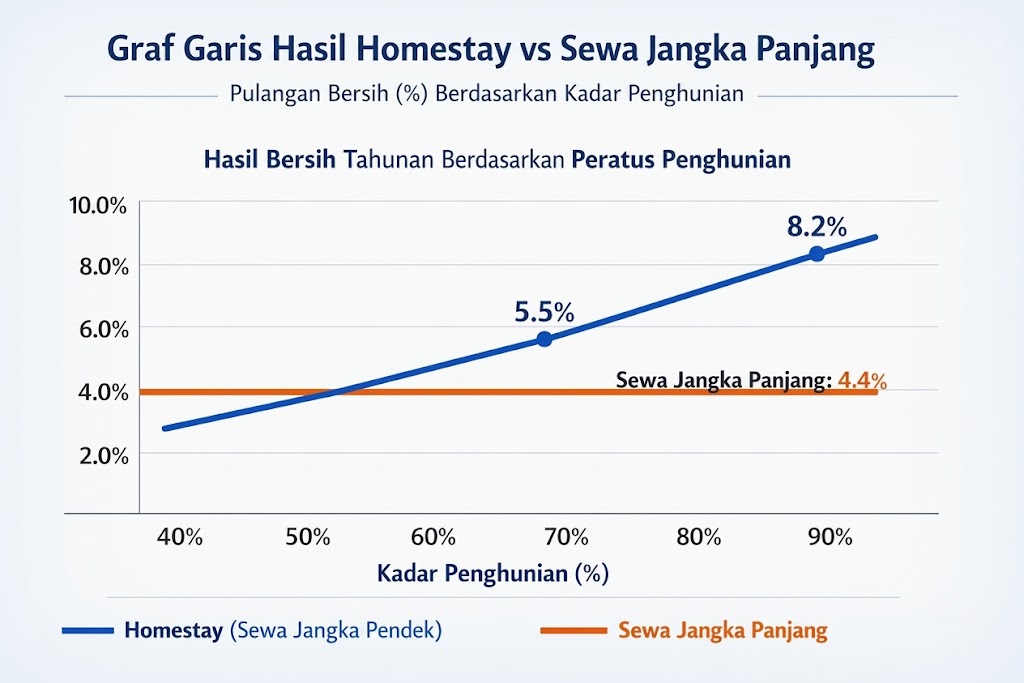
Homestay net income percentage = (RM30,181 / RM550,000) x 100 = approximately 5.5%.
Now, compare this with a regular long-term lease for a similar unit, say RM2,000 per month, equivalent to RM24,000 per year (before deducting any maintenance costs). Long-term lease gross yield percentage = (RM24,000 / RM550,000) x 100 = approximately 4.4%.
In this example, the homestay (5.5% net) still shows a higher yield compared to the long-term lease (4.4% gross, before any other costs), but the gap is much narrower compared to if you only compare the raw rate without considering costs and vacancy risks.
If you calculate it purely without costs, RM180 x 365 nights = RM65,700 per year, giving a "gross" yield of 11.9%, a much more attractive figure but completely unrealistic as it assumes the unit is booked every single night throughout the year without any operational costs. Comparing this unrealistic 11.9% figure with the more accurate 5.5% after considering occupancy and actual costs shows how important it is to use a calculator that takes into account all factors, not just the per-night rate displayed on booking platforms.
Practical Tips and Risks to Consider
- Occupancy rates can vary greatly depending on the season and location. Units near major tourist attractions may reach 70-80% during peak season but drop significantly lower during off-peak times, use a realistic annual average, not just peak season figures.
- Check the STR registration requirements and local council guidelines in your state. Some local authorities in Malaysia have specific registration, licensing or restrictions for short-term rental operations, failure to comply may result in penalties or enforcement actions.
- Don't ignore "hidden" costs such as faster wear and tear of furnishings, linen and equipment due to frequent guest turnover, compared to long-term tenants who take better care of the unit.
- Consider the time and effort of management. If you don't use a management company, managing bookings, guest communication and cleaning yourself will take significant time compared to just collecting monthly rent once a month from long-term tenants.
- Compare both strategies using realistic assumptions, not the most optimistic ones. It's easy to be tempted to use peak season occupancy rates throughout the year in calculations, but this will give an overly positive picture compared to the reality of operations over 12 months.
- Some investors choose a hybrid strategy, operate as a homestay during school holidays and festive periods (high demand), then switch to short-to-medium term rentals during other months to maintain more stable cash flow throughout the year.
- Review the building's property management regulations (management corporation or JMB). Some strata management companies prohibit or restrict short-term rental operations in their buildings, so check first before planning a homestay strategy for your unit.
- Guest reviews and feedback have a big impact on long-term occupancy rates. New units without a review history usually require a lower initial occupancy rate than average, before reputation is built and bookings become more consistent.
- Recalculate homestay income every few months. Tourism demand and daily rental rates can change according to the season, national tourism policies and new unit competition in the surrounding area, so today's valid estimates may need to be reviewed soon after.
Try this calculator for free at Homestay Yield Calculator.
Note: All numbers in this article are illustrative estimates for planning purposes only, not financial or investment advice. Actual occupancy rates and demand vary according to location and season, please conduct a local market study before making a decision.