Many people who buy new cars are surprised when they recalculate, the quoted interest rate of 2.8% from the bank seems "cheap", but the total interest that needs to be paid over the loan period appears large compared to expectations. This is not a miscalculation by the bank, it is because car loans in Malaysia use the flat rate method, a method that fundamentally differs (and is more "expensive" in terms of actual impact) compared to the reducing balance method used for home loans. Our Vehicle Loan Calculator helps you see the real numbers before signing the hire purchase agreement.
What is the flat rate method, and why is it different
Before diving into technical details, it is important to first understand why this matters to you as a consumer. Cars are usually the second biggest purchase for most households in Malaysia after homes, and the monthly instalment commitment can continue for many years. Misunderstanding how the actual cost is calculated can cause you to choose an unsuitable loan term or amount, simply because the quoted rate appears low compared to the actual cost.
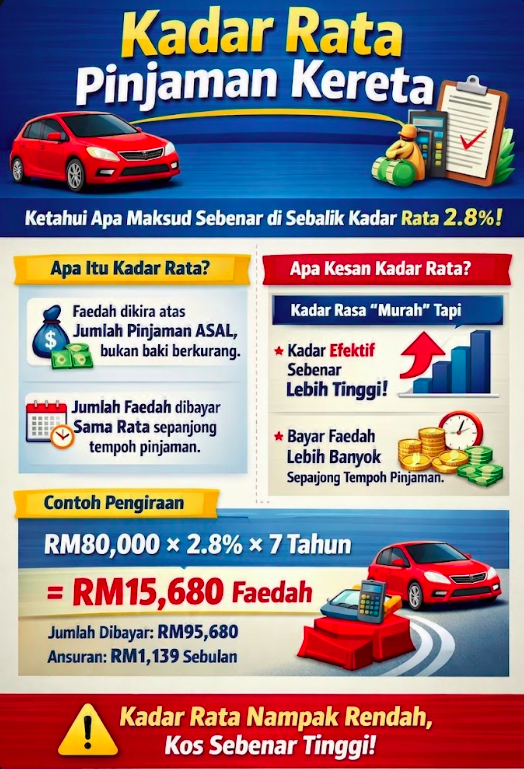
Car loans (hire purchase) in Malaysia conventionally use the flat rate method. The difference with the reducing balance method (used for home loans) is very important to understand: in the flat rate method, interest is calculated on the TOTAL ORIGINAL LOAN AMOUNT (the amount financed after deducting the down payment), and this total interest is spread EQUALLY across the entire loan period, without taking into account that the outstanding loan balance should decrease each month as you make payments.
This calculator uses an illustrative average interest rate of 2.8% per year, with a term option between 1 to 9 years.
The term "hire purchase" itself describes the structure of this agreement; legally, you are actually "renting" the vehicle from the financing company for the duration of the loan, and ownership only transfers fully to you after the final installment is paid. This is why the vehicle ownership certificate (geran) will show the financing company as the registered owner throughout the financing period until the loan is fully settled.
The actual formula, and why the 'effective' rate is much higher
The formula is:
Total interest = Vehicle price (after down payment) x Average rate x Number of years
This total interest is then spread equally throughout the loan period, without taking into account the decreasing balance.
This brings us to the most commonly misunderstood point by many car buyers in Malaysia: the reason interest is calculated on the original loan amount throughout the entire term (not on the decreasing balance as in a home loan), the "effective" rate you practically experience is roughly TWICE the average rate quoted. This is because, in the later months of the loan, the actual remaining balance you owe is much smaller than the original amount, but you still pay interest as though the balance had not decreased at all. Hence, the 2.8% rate that looks "cheap" effectively feels more like 5.5% to 6% when compared to the more transparent reducing balance method.
Many new car buyers fall into this unfair comparison: they compare the flat rate car loan rate of 2.8% with the reducing balance home loan rate of 4.0%, and conclude that car loans are "much cheaper". In reality, if compared fairly on the same basis (effective rate), a flat rate car loan at 2.8% could actually be more expensive than a reducing balance home loan at 4.0%. This is why it's important that you can't directly compare two interest rates without understanding the calculation method behind them.
Example: RM90,000 car with RM10,000 down payment
Say you buy a car priced at RM90,000, with a down payment of RM10,000, so the amount financed is RM80,000. You choose a 7-year term at a flat rate of 2.8% per year.
Total interest = RM80,000 x 2.8% x 7 years = RM15,680
Total amount to be paid over the term = RM80,000 + RM15,680 = RM95,680
Monthly instalment = RM95,680 divided by 84 months (7 years x 12) = approximately RM1,139 per month
It looks reasonable when you just see the 2.8% rate, right? But remember, because the flat rate method calculates interest on the full RM80,000 throughout the 7 years (even though the actual balance has significantly reduced by year 5 or 6), the effective rate you're actually paying is much higher than 2.8% when compared fairly with the reducing balance method, roughly double, around 5% to 6%. This is why it's important for you to understand before comparing "rates" of car loans with "rates" of home loans, they can't be directly compared because the calculation methods are completely different.
For comparison, if the loan term is shortened to 5 years for the same financing amount of RM80,000: total interest = RM80,000 x 2.8% x 5 years = RM11,200, total amount = RM91,200, and monthly instalment = RM91,200 divided by 60 months = approximately RM1,520 per month. The monthly instalment is higher compared to the 7-year term, but the total interest paid (RM11,200) is much lower compared to RM15,680 for the 7-year term, saving more than RM4,000 just by shortening the term by two years.
This also shows why many financial advisors recommend avoiding excessively long car loan terms (for example, 9 years) even though the monthly instalments may seem very light, because the total interest accumulated over a long period can become very large compared to the original financing amount, and the car's value will depreciate rapidly during the same period, leaving you in a "negative equity" situation (outstanding debt higher than the car's value) for a longer period.
Practical tips and common mistakes
- Do not compare car loan rates directly with home loan rates. A 2.8% average car loan rate is not equivalent to a 4.0% reducing balance home loan rate, effectively the car loan rate is higher.
- Larger down payments reduce total interest. Because interest is calculated on the amount financed, a larger down payment means a smaller interest calculation base, thus the total interest paid is lower.
- Shorter terms save total interest. Although monthly installments are higher, a shorter term means a smaller number of years in the formula, thus the total interest paid is lower.
- Avoid paying early settlement penalties without checking. Some hire purchase agreements have penalties if you settle the loan earlier, check these terms before signing.
- Understand average rates are not a scam, they are industry norms. This does not mean the bank is "scamming" you, the average rate method is a standard convention for car loans in Malaysia, the key is that you understand how the calculation works so you can make an informed decision.
- Used cars (used car) usually have higher rates. The average rate for financing a used car is usually higher than for a new car, because the risk borne by the financier is higher, take this into account when comparing quotes.
- Consider the additional costs of car ownership. In addition to monthly installments, remember other costs such as vehicle insurance, road tax, and maintenance, so that the total monthly commitment for the car does not burden your budget.
Try this calculator for free at Vehicle Loan Calculator.
Note: The rates and figures in this calculator are illustrative estimates based on average rates, not official loan offers. The actual rate will be determined by the bank or financial institution based on your credit profile.