Many people put money into Fixed Deposits while assuming it functions like other investments, where the profit also generates additional profit from time to time. In reality, Fixed Deposits in Malaysia use a completely different calculation method. The Fixed Deposit Calculator on HartanahBumiputera helps you accurately calculate how much interest you will receive, based on the actual way Fixed Deposits are calculated in most banks.
What This Calculator Calculates
This calculator takes three inputs: the principal amount you deposit, the annual interest rate offered by the bank, and the deposit period in months. From there, it calculates the total interest you will receive, and the maturity value, which is the total principal plus the interest earned over the period.
This is especially useful when you compare several Fixed Deposit offers from different banks, or compare different deposit periods, for example 3 months versus 12 months, to see the actual impact on the amount you will receive at the end of the deposit period.
Many people choose Fixed Deposits because it is seen as one of the safest and easiest-to-understand savings methods in Malaysia, especially for those who are not comfortable with the ups and downs of the stock or unit trust market. Compared to other investment instruments whose values can rise and fall according to the market, Fixed Deposits offer certainty, meaning you know exactly how much you will receive on the maturity date, as long as the money is not withdrawn before the term ends.
Moreover, many people use Fixed Deposits as part of their diversification strategy in their personal financial portfolios, placing a portion of their funds in low-risk instruments such as Fixed Deposits, while another portion is placed in higher-risk investments that have the potential to provide greater returns. This combination helps balance the need for money growth and the need for certainty and peace of mind, especially during times of economic uncertainty when other investment markets become more volatile than usual.
Quick Benefits: Key Difference With Compound Interest
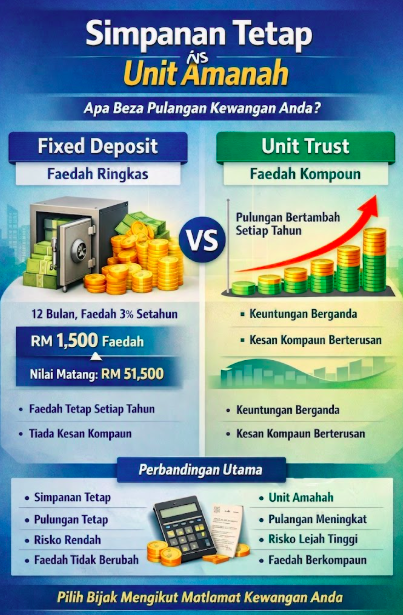
Fixed Deposits in Malaysia use simple interest, not compound interest. This is an important difference that many people are not aware of. The formula is: the interest earned is equal to the principal amount multiplied by the annual interest rate, multiplied by the period in months divided by 12. The maturity value is the principal amount plus the interest earned.
Compare this with something like unit trust funds or other investments that compound, where the profit you earn in the first year starts to generate additional profit in the second year, and so on, causing growth to accelerate over time. Fixed Deposits do not work this way. Interest is calculated only once, directly from the original principal amount, for the entire placement period, without any "compounding" effect even if you renew the deposit repeatedly, unless you specifically add the interest earned to a new principal during the renewal process.
Sebab inilah tempoh penempatan memainkan peranan yang sangat langsung dan berkadar terus (proportional) terhadap jumlah faedah yang anda perolehi. Letak wang untuk tempoh dua kali ganda lama, anda perolehi faedah dua kali ganda banyak (pada kadar yang sama), tidak lebih, tidak kurang, kerana tiada kesan kompaun yang mempercepatkan pertumbuhan faedah anda.
Ini penting untuk difahami terutamanya bagi mereka yang membandingkan Simpanan Tetap dengan produk simpanan atau pelaburan lain yang mengiklankan "kadar pulangan tahunan" yang kelihatan setanding. Since Fixed Deposit does not compound, two products with the same annual rate can yield different final results if one of them compounds monthly or annually, whereas Fixed Deposit remains on a simpler interest calculation that is easier to predict but not "accelerated" by compounding.
Example Calculation: RM50,000 For 12 Months Compared To 6 Months
Say you place RM50,000 in a Fixed Deposit at a rate of 3.0% per annum, for a period of 12 months. Using the formula above, the interest is equal to RM50,000 multiplied by 3.0% multiplied by (12 divided by 12), that is RM50,000 multiplied by 0.03 multiplied by 1, equal to RM1,500. Therefore, at the end of 12 months, your matured value is RM50,000 plus RM1,500, that is RM51,500 in total.
Now, compare if the same RM50,000 is placed at the same rate of 3.0% per annum, but for a period of only 6 months. The same formula is used: interest is equal to RM50,000 multiplied by 3.0% multiplied by (6 divided by 12), that is RM50,000 multiplied by 0.03 multiplied by 0.5, equal to RM750.
The matured value at the end of 6 months is RM50,000 plus RM750, that is RM50,750 only.
Note how the benefit for a 6-month period (RM750) is exactly half of the benefit for a 12-month period (RM1,500), since a 6-month period is half of a 12-month period. This clearly shows the "linear" nature of simple interest, meaning that the interest grows at a constant rate with time, without any compounding acceleration effect that you might expect from more complex forms of savings or investments.
If you try to compare the option of placing RM50,000 in a single 12-month placement, versus two consecutive 6-month placements at the same rate, the final result will be the same as long as the interest rate remains unchanged between the two 6-month periods, because simple interest does not provide any additional advantage to longer periods over renewed shorter periods, as long as the annual rate itself remains the same throughout.
Practical Tips for Fixed Deposits
- Compare rates between banks before placing your money, because Fixed Deposit rates can vary slightly between banks and terms, even though the difference may seem small at first.
- Consider a term that suits your liquidity needs. Withdrawing a Fixed Deposit before maturity usually causes you to lose some or all of the interest you would have earned.
- Don't assume that interest will "grow faster" if you leave it longer. Since it's simple interest, there's no compounding advantage for longer terms compared to renewing periodically at the same rate.
- Consider renewing your Fixed Deposit by adding the earned interest to a new principal, if you want to achieve some manual compounding effect over several consecutive maturity periods.
- Use Fixed Deposits for funds you are certain you won't need in the near future, and keep more liquid emergency funds in a regular savings account that allows withdrawals at any time without penalty.
- Check whether the bank offers special rates for certain terms or amounts. Sometimes short-term promotional rates can exceed regular long-term rates, so it's worth comparing several options before making a deposit, and don't hesitate to ask bank staff directly about any ongoing promotions, as such promotional rates are usually only offered for a limited period and not widely advertised to the public.
Understanding that Fixed Deposit uses simple interest, not compound, helps you set accurate expectations and make fair comparisons between various offers and terms. It is a simple and secure product, but not a fast-growth tool like other compound investments.
Try this calculator for free at Fixed Deposit Calculator.
Note: The actual interest rate of Fixed Deposit varies according to the bank, principal amount, and term, and may change from time to time. Please refer to the latest official rates from your preferred bank before making a decision.