You've found your dream home, have enough down payment, but your home loan application is still rejected by the bank. Why? Most likely because of one number that the bank automatically calculates before looking at anything else, which is Debt Service Ratio (DSR). The DSR calculator on this page helps you calculate this number first, so you know your chances of approval before wasting time applying and getting rejected.
What Is DSR and Why It Is the Most Important Number
DSR is the percentage of your monthly net income that is "committed" to pay all monthly debt obligations, including the new home loan you have just applied for. Banks use this number as the primary filter to determine whether you can afford another monthly instalment without affecting your daily finances.
Compared to other factors such as gross salary, type of job, or the value of the property purchased, DSR is usually the most critical single determinant in the bank's decision to approve or reject a home loan. In fact, someone with a high salary but many other debt commitments (car, credit card, personal loan) can be rejected, while someone with a lower salary but clean of other debts can be approved easily.
DSR also determines how large a home loan you can apply for, not just whether you are approved or not. Banks will limit the loan amount to a level where the monthly instalment does not cause the overall DSR to exceed the allowed limit for your income group. This means, indirectly, that DSR also determines the realistic price range of homes you can look for, not just how much down payment you have.
Many potential home buyers only think about how much down payment they need to collect, and completely forget about DSR until their loan application is rejected. By calculating DSR first using this calculator, you can plan better, whether you need to reduce existing debts first, find a cheaper property, or add a joint applicant to increase the net income considered.
Formula and Limits Used by Banks
The DSR formula is very simple:
- DSR (%) = Monthly Debt Commitment / Net Monthly Income x 100
The monthly debt commitment includes all existing installments (car loans, personal loans, minimum credit card payments) PLUS the installment of the new home loan you are applying for. Net monthly income is your salary after deductions such as EPF, income tax and others, not gross salary.
Banks in Malaysia generally use the following guidelines as DSR limits:
- 60% for borrowers with net income below RM10,000 per month
- Up to 70% for borrowers with net income RM10,000 per month or more
Keep in mind, these are general benchmarks commonly used as public references, some banks may allow higher DSR at their discretion and case-by-case assessment, especially if the borrower's credit profile is very strong. But as a planning guideline, 60% and 70% are good thresholds for you to use when planning.
Note also that this limit varies according to income level, not a single figure for everyone. That is why it is important for you to calculate your own DSR based on actual net income, not assuming that the 60% limit applies to everyone regardless of salary. Someone earning RM12,000 per month may still be approved at a DSR of 65%, whereas someone earning RM8,000 per month at the same DSR (65%) is likely to be rejected because it exceeds the 60% limit for their income group.
Calculation Example: Salary RM6,000 Per Month
Let's take an example of someone with a net income of RM6,000 per month. He is currently paying a car installment of RM800 per month, and now wants to apply for a new home loan with an estimated monthly installment of RM1,600 per month (this estimate is based on current interest rates based on OPR).
Total monthly debt commitment = RM800 (car) + RM1,600 (new home loan) = RM2,400.
DSR = (RM2,400 / RM6,000) x 100 = 40%.
Since his net income (RM6,000) is below RM10,000, the relevant DSR limit for him is 60%. With a DSR of 40%, he is well below that limit, meaning his financial profile appears healthy in terms of debt ratio, and the loan application (as far as this DSR criterion is concerned) has a good chance of approval.
As a comparison, if he has an additional personal loan of RM1,200 per month, the total commitment will rise to RM3,600, making DSR (RM3,600 / RM6,000) x 100 = 60%, which is exactly at the limit. In this situation, the bank may become more cautious or ask for the loan amount to be reduced.
Practical Tips and Common Mistakes
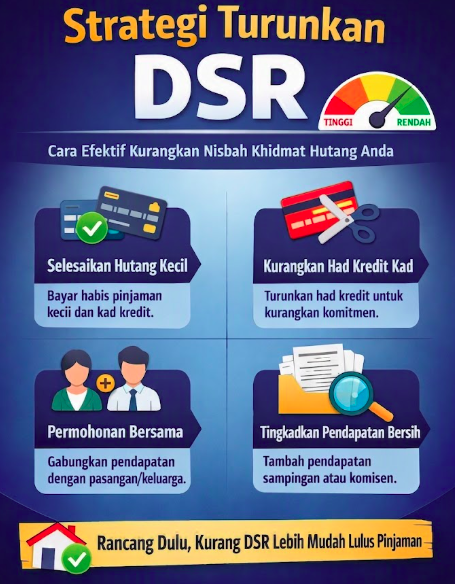
- Settle or reduce small debts before applying for a home loan. Closing car loans or credit cards that are nearly paid off can significantly lower your DSR, and this could be the difference between approval or rejection.
- Don't forget to calculate your credit card limit, not just the outstanding balance. Some banks calculate commitments based on minimum payments against the full credit limit, not the actual amount you use.
- Understand that DSR is calculated on your NET income, not gross salary. Many applicants mistakenly assume their gross salary and miscalculate how much they "can afford".
- If you have irregular income (self-employed) or commission-based, banks usually use the average income from the past few months or years, so prepare consistent bank and tax statements to facilitate the assessment.
- A healthy DSR is not a guarantee of automatic approval. It is only one of several criteria banks consider, but it is usually the first criterion that screens applications.
- Consider a joint application with your spouse or family member if your individual DSR is too high. This combines the net income of both applicants, which can significantly lower the overall DSR, although it also means both parties are responsible for the loan.
- Avoid applying for new credit cards or loans just before applying for a home loan. Every new commitment adds to your DSR denominator and can affect your eligibility at the most critical moment.
- Consider commitments as a guarantor for someone else's loan. Some banks also include this commitment in your DSR even if you are not the main borrower, so take this factor into account when planning.
- Plan well before starting to look for a house. Calculate your DSR a few months before starting to hunt for property, so you have time to reduce existing debts if needed, and not just realize it after falling in love with a particular house.
- Keep updated salary and bank statements. Banks need these documents to verify your actual net income, and any discrepancies between your estimates and the actual documents can delay or affect the approval process.
- Understand that your DSR can vary slightly between banks. Some banks have slightly different methods of calculating income or commitments (for example, how they handle commission or bonus income), so the DSR estimate from this calculator is a good starting point, not the final figure from each bank.
Before you go to the bank, use this calculator to check your own ratio. This can save time and also avoid unnecessary credit inquiries on your CCRIS/CTOS report due to applications that may be rejected.
Try this calculator for free at Debt Service Ratio (DSR) Calculator.
Note: All numbers in this article are illustrative estimates for planning purposes only, not financial advice. Actual approval criteria vary by bank and may change, please refer to your bank officer for official assessment.