If you are evaluating a shop, office space or any other commercial property for investment, there is one measure used by professional investors and property valuers worldwide to compare the "income-generating power" of an asset, regardless of how it is financed. This measure is Capitalization Rate (Cap Rate), and the NOI & Cap Rate Calculator on this page helps you calculate it accurately using your own property figures.
What Is NOI, Cap Rate, and Why It Differs From Ordinary Yield
NOI (Net Operating Income) is the annual rental income of a property after deducting operating costs, BUT before deducting any loan payments or financing costs. This is a big difference compared to metrics such as CoCR or net rental yield, which take into account cash flow AFTER loan payments. Many beginners in commercial real estate investment are confused between NOI and net cash flow, and mistakenly assume they are the same, whereas the main difference lies in whether loan payments have been deducted or not.
Why is this difference important? Because cap rate is designed to measure the income-generating power of the property ITSELF, independent of how it is financed. This allows investors to compare a deal bought outright with another bought using bank leverage, on an equal footing. That is why cap rate is very popular for evaluating and comparing commercial or investment-grade properties, where buyers may have very different financing structures from one another.
Although cap rate is often associated with commercial properties such as shops, offices or warehouses, the same concept can also be used for residential properties that are rented out, especially by investors who want to compare several units without being affected by differences in how each unit is financed. It provides a "clean" basis for comparison before personal factors such as the amount of down payment or each unit's loan rate are taken into account.
Cap Rate Formula
The first step, calculate NOI:
- NOI = Annual Rental Income - Annual Operating Expenses
Operating expenses here include maintenance, insurance, property taxes, property management costs and so on, but DO NOT include bank loan instalment payments.
Then, the cap rate is calculated by:
- Cap Rate (%) = NOI / Market Value x 100
Market value here refers to the current property price or estimated market value (for example, through official valuation or an Automated Valuation Model based on comparable transactions). A higher cap rate generally indicates a higher income return relative to the property value, but it is also usually associated with higher risk (for example, less strategic location or less stable tenants), just like the risk-return principle in most other asset classes.
This calculator also allows you to enter the amount invested and net cash flow after loan payments (if applicable), to display the Cash-on-Cash Return figure alongside as a comparison. This is useful to see how leverage changes your actual return compared to the property's basic income-generating power.
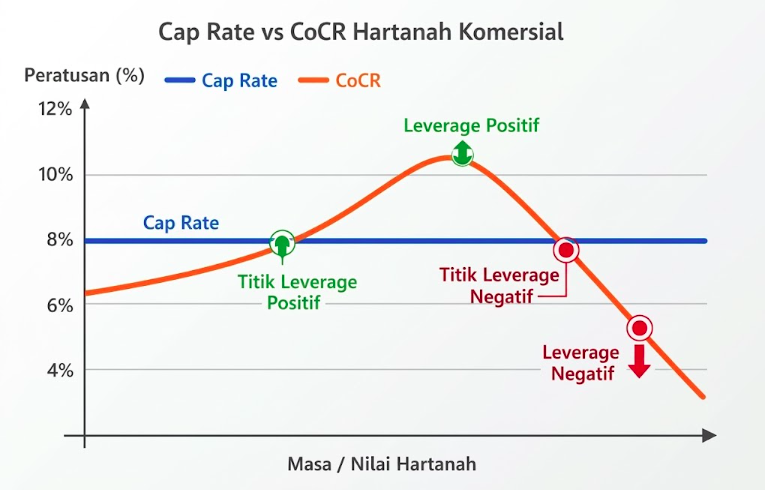
For example, a property might have a cap rate of 6% (basic income power), but after taking bank leverage wisely, the actual CoCR of the owner could be higher than 6%, because the loan cost is lower than the return rate of the property itself, a phenomenon called "positive leverage". Conversely, if the loan cost is higher than the cap rate, leverage can actually lower the CoCR compared to the original cap rate, called "negative leverage". Looking at both figures side by side helps you understand which situation you are in.
Calculation Example: Small Shop Worth RM1,200,000
Say you are evaluating a small shop lot with a market value of RM1,200,000. This shop is rented to a trader with an annual rental income of RM96,000, and the annual operating expenses (maintenance, property tax, insurance) are estimated at RM18,000 per year. For the cap rate calculation, we assume no loan (all-cash), so the figure reflects only the income power of the property itself.
NOI = RM96,000 - RM18,000 = RM78,000 per year.
Cap Rate = (RM78,000 / RM1,200,000) x 100 = 6.5%.
This 6.5% figure can be directly compared to the cap rate of other commercial properties in the same area, without worrying whether other properties were bought in cash or using bank loans, because the cap rate measures the income power of the asset, not the buyer's financial structure. If comparable properties in nearby locations show an average cap rate of 5.5%, then this RM1,200,000 shop (at 6.5%) may be considered more attractive in terms of its relative income to its price.
If the shop owner takes a bank loan for part of the purchase price, say RM800,000 out of RM1,200,000, with cash invested (down payment, legal fees, stamp duty) amounting to RM450,000, and the annual net cash flow after loan payments is RM40,000, then CoCR = (RM40,000 / RM450,000) x 100 = 8.9%. In this case, CoCR (8.9%) is higher than the cap rate (6.5%), showing that the bank leverage actually improves the return on the owner's cash, since the loan costs they pay are lower than the property's return rate.
Practical Tips and Common Mistakes
- Don't mix up cap rate with CoCR. Cap rate is about the property's income potential BEFORE financing, CoCR is about the return on your cash AFTER financing. Both are useful, but they answer different questions.
- Compare cap rates only within the same property category and location. Retail shop cap rates in major urban areas usually differ greatly from warehouse cap rates in industrial zones, due to differing risk profiles and tenant stability.
- Ensure that the operating expenses used are realistic and complete. Many sellers or agents provide overly optimistic NOI estimates by omitting some actual operating costs, so check the actual property financial statements carefully if available.
- High cap rate isn't automatically "better". It may indicate higher risk (e.g. less stable tenants or less strategic location), so consider cap rate alongside other qualitative factors before making a decision.
- Use cap rate for quick screening, and CoCR for final decisions. Cap rate is good for quickly comparing commercial property listings, but actual purchase decisions should consider your actual financing structure through CoCR, especially if you plan to use a bank loan.
- Check existing rental trends and tenancy terms. A shop with a stable long-term tenant is generally considered less risky than a shop with frequent tenant turnover, even if both have the same cap rate.
- For large commercial properties, get a separate professional valuation. Although this calculator provides useful cap rate estimates for initial comparisons, high-value investment decisions should be supported by formal valuations and more in-depth due diligence.
- Consider potential rising operating costs over time. Property taxes, insurance premiums and maintenance costs tend to increase with inflation. A healthy NOI today could shrink several years later if rents don't keep pace with rising operating costs.
Try this calculator for free at NOI & Capitalization Rate (Cap Rate) Calculator.
Note: All figures in this article are illustrative estimates for planning purposes only, not financial or investment advice. Actual commercial property values should be assessed by a licensed appraiser before any purchase decisions are made.