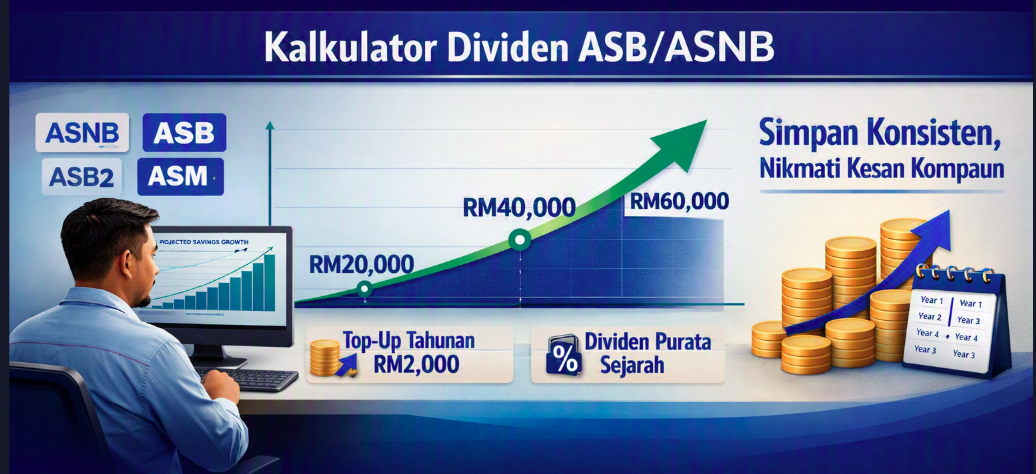
ASB may be one of the most widely owned saving products among Bumiputera families in Malaysia, but many save without ever really considering where their savings will take them in 10 or 20 years' time. The ASB/ASNB Dividend Calculator tries to bridge that gap, by projecting the growth of your savings based on actual historical dividend data for each ASNB fund.
What This Calculator Does
This calculator projects the growth of money placed in any ASNB fund, such as ASB, ASB2, ASM, or similar funds, plus your optional annual top-up contributions, over the number of years you set. Unlike generic calculators that use a single uniform return assumption, this calculator is based on the actual historical data of each individual ASNB fund, since each fund has its own eligibility criteria and historical dividend records. The default projection rate suggested by this calculator is based on the actual historical average of the selected fund, not a generic number applied uniformly to all ASNB funds.
This is important because many savers only look at the current year's dividend rate without considering how it grows in the long term when combined with continuous top-ups. With year-by-year projections, you can see more clearly whether a consistent saving strategy in ASB, compared to saving sporadically without a plan, really makes a big difference to your long-term final balance.
Why ASNB Funds Are So Popular
There are two main reasons why ASNB funds like ASB continue to be a popular preferred savings vehicle among Malaysians, especially Bumiputera. First, the capital is generally protected, since the net asset value (NAV) remains at RM1.00 and does not fluctuate like the unit prices of conventional trust funds, which change daily according to the market. Second, the historical dividend rate is often attractive compared to conventional fixed deposits, making it an appealing savings option for the long term.
However, it is important to note honestly that historical dividends are not a guarantee of future dividends. Fund managers declare dividend rates each year based on the actual investment performance of the fund for that year, so the announced rate may vary from year to year, although it is rarely negative considering the fund's capital protection structure.
Each ASNB fund is also designed for slightly different target groups. ASB is generally open to Bumiputera members without strict age limits, ASB2 is often associated with different target groups or savings limits, while ASM (Amanah Saham Malaysia) is open to all Malaysians regardless of ethnicity. Due to the varying eligibility criteria and savings limits, the historical dividend rates of each fund are recorded separately, which is why this calculator allows you to select a specific fund before viewing the projection, rather than using a single uniform figure for all ASNB funds.
Example Projection: RM20,000 With RM2,000 Top-Up Per Year
Say someone makes an initial deposit of RM20,000 in the ASB, and adds RM2,000 each year as additional contributions, with projections over 10 years, using an illustration rate that represents the historical average ASB dividend rate.
In the first year, the dividend is calculated on the balance of RM20,000 (plus any top-up added during that year, depending on when the top-up is made). The dividend received subsequently joins the principal balance, making the basis for calculating the dividend in the second year larger. Each subsequent year, a new RM2,000 top-up is added, and the compounding process repeats on the ever-increasing balance.
Over 10 years, two factors contribute to the growth of the savings: the total principal contributed (initial RM20,000, plus RM2,000 each year, i.e., RM20,000 from top-ups over 10 years, making the total principal amount RM40,000), and the compounding effect of annual dividends on the continuously growing balance. At the illustration rate representing the historical average of ASB, the ending balance after 10 years reasonably could exceed the total principal contributed by a significant margin, although the exact figure depends entirely on the actual dividend rate declared each year throughout the period, which varies and cannot be accurately predicted in advance.
For comparison, if the same investor chooses not to make any annual top-ups, and simply allows the initial RM20,000 to grow on its own over 10 years, the principal contributing to the final balance would only be RM20,000, much lower than RM40,000 if consistent top-ups are made. This clearly shows why the habit of continuous saving, even in small amounts each year, has a much greater impact compared to relying solely on initial savings, because every ringgit of top-up also enjoys the compounding effect of dividends throughout the remaining projection period.
Smart Tips for Using ASNB Savings
- Check the eligibility criteria for each fund. ASB, ASB2, and ASM have different membership eligibility criteria and maximum deposit limits, make sure you are eligible before planning large deposits.
- Consistently topping up makes a big difference in the long run. Even though the annual additional amount is small, it contributes significantly to the final balance due to the compounding effect over the years.
- Don't assume last year's dividend will repeat every year. The declared rate each year is based on the fund's performance, use historical averages as a reasonable guide, not a guarantee.
- Compare different ASNB funds based on their historical records. Each fund has its own dividend history, don't assume all ASNB funds provide the same rate.
- ASB deposits are suitable as a base for long-term savings. Especially for those who want better growth than fixed deposits, but still prioritize capital protection.
- Make top-ups a habit, not just an intention. Setting up fixed monthly or annual instructions to your ASB account makes it easier to stay consistent, rather than relying on memory or leftover balances at the end of the year.
- Understand the difference between ASB and high-risk investments. ASB is suitable for stable basic savings, but for more aggressive growth, some savers combine it with other investments that have different risk profiles and returns.
Who This Calculator Is Most Useful For
This calculator is suitable for various stages of financial life. For those who have just started working, it helps demonstrate the power of consistent top-ups from a young age, even in small amounts each month or year. For parents, it is useful for planning their children's education savings, by placing money into an ASB account under the child's name (subject to applicable eligibility criteria) and viewing the growth projection until the child reaches university entrance age. For those approaching retirement age, it helps assess whether existing ASB savings, combined with other sources such as KWSP, are sufficient to cover some of the financial needs during retirement.
Importantly, this calculator is not just a calculation tool, it is also a financial education tool. By seeing firsthand how small, regular top-ups can grow into significant amounts over the years due to the compounding effect, many savers become more motivated to maintain consistent saving habits, rather than saving inconsistently only when there is spare money. Try several different scenarios in the calculator, change the annual top-up amount, projection period, or selected fund, to see for yourself how each small change affects your long-term final balance.
Try this calculator for free at ASB/ASNB Dividend Calculator.
This projection is an illustrative estimate based on historical dividend rates, not a guarantee of future dividends. It is not investment advice, please refer to ASNB officially for the latest fund information and eligibility criteria.