What is Faraid?
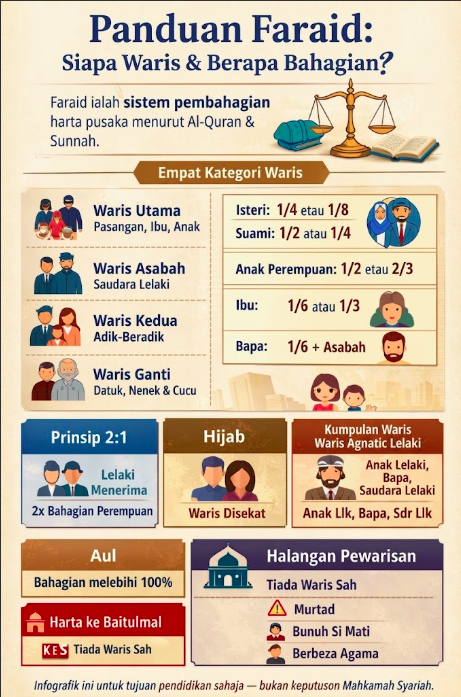
Faraid is an inheritance distribution system established in the Quran and Sunnah, determining precisely who is entitled to inherit the property of a deceased Muslim, and what share each is entitled to. Unlike the free will bequest system where a person can distribute their assets according to their own wishes, faraid is a fixed provision that cannot be changed at the discretion of the deceased, with the aim of ensuring fair distribution across generations, protecting the rights of groups that may be marginalised (such as daughters and mothers) from being completely excluded.
This article explains the basic mechanics of faraid, who the heirs are, what share each one receives, and the key concepts that need to be understood before using the Faraid Calculator on this site.
Four Categories of Heirs
According to the official guidelines from Selangor Islamic Religious Council (MAIS), faraid heirs are grouped into four categories:
- Main Heirs — spouse, parents and children. The closest relatives who usually receive a fixed share (fardh).
- Asabah Heirs — mostly male siblings who inherit the remainder of the estate after the fixed shares have been distributed.
- Secondary Heirs — siblings and their descendants, who inherit only when certain main heirs (children, father) are absent.
- Substitute Heirs — grandfather/grandmother and grandchildren, who inherit in place of a missing generation.
Note on scope: The calculator on this page includes core heirs, spouse, children, parents and siblings (full siblings, half-siblings, step-siblings), since this is the family structure in the majority of actual cases in Malaysia.
Grandparents, grandchildren and distant heirs are intentionally not modelled since their rules (hijab) are much more complex and high risk of error if estimated automatically, such cases require an official Faraid certificate.
Fixed Shares (Fardh)
The following are the most common fixed shares:
- Spouse — wife/wives receive 1/4 (if the deceased has no children) or 1/8 (if there are children), shared equally if there is more than one wife. Husband receives 1/2 (no children) or 1/4 (has children).
- Daughter(s) (no sons) — one daughter receives 1/2; two or more share 2/3.
- Mother — 1/6 if the deceased has children or two or more siblings; if not, 1/3 (with the exception of Umariyyatain — see below).
- Father — 1/6 fixed if the deceased has children; if there are no sons, father also receives the remainder (asabah) after other fixed shares have been distributed.
- Siblings from the same mother (only if no children and no father) — one sibling receives 1/6; two or more share 1/3 equally (not according to male:female ratio).
Principle "Male Receives Twice as Much as Female" — And Why
Sons and brothers (full brothers) receive twice the share of their sisters when inheriting as asabah (residue). This is often misunderstood as "discrimination," but it needs to be understood in the context of the financial responsibilities placed on men in Islam, such as providing for one's wife, children, and sometimes parents, which are the duty of men, whereas the property received by women (dowry, maintenance from the husband, faraid) is entirely their own without any obligation to support others. The ratio of 2:1 reflects the distribution of responsibilities, not the value of an individual.
Asabah: Who Inherits the Residue?
After all the fixed shares (fardh) have been distributed, any residue is given to asabah, usually sons, or the father if there are no sons, or brothers if there are no sons and father. There are also special situations where daughters or sisters can also become "joint" asabah (asabah ma'al ghayr) when paired with a full brother or (in certain cases) when there are daughters without sons.
Hijab: When an Heir is "Blocked"
Some heirs can be completely blocked (hijab hirman) by the existence of a closer heir. The most basic example: the existence of a son blocks all the deceased's siblings from inheriting anything, even if the siblings themselves have many children. There is also partial blocking (hijab nuqsan) where the existence of one heir reduces (but does not eliminate) another heir's share, for example, the existence of children reduces the mother's share from 1/3 to 1/6.
Two Special Cases: 'Aul and Umariyyatain
'Aul occurs when the total of all fixed shares (fardh) entitled to heirs exceeds the entire estate (e.g. wife + 2 daughters + father + mother can produce a total exceeding 100%). In such cases, all shares are reduced proportionally so that the total returns to 100%, no heir "loses" a share, only all receive slightly less than their original proportional and fair share.
Umariyyatain (also known as Gharrawan) is a special case when the deceased leaves a spouse AND both parents, without any children. In this situation, the mother receives 1/3 of the remainder after the spouse's share, not 1/3 of the entire estate as usual. This results in the mother's share being slightly smaller than a simple calculation would suggest, and the father receives the remainder as asabah.
When Inheritance Goes to Baitulmal
If after all fixed shares and asabah have been distributed there is a remainder not claimed by anyone (because there are no eligible asabah heirs), the remainder transfers to Baitulmal (the state Islamic religious council treasury). This is an official administrative practice in Malaysia, as stated by MAIS itself. This also happens entirely (100% of the estate) if the deceased leaves no valid heirs.
When Heirs Lose Their Full Right to Inherit
There are situations where someone who biologically/maritally should be an heir, loses their full right to inherit:
- Killing the deceased — the killer cannot inherit from the deceased.
- Apostasy — leaving Islam.
- Religious differences — a non-Muslim cannot inherit from a deceased Muslim, and vice versa.
Conclusion: Use This as a Starting Point, Not a Final Decision
Faraid is a detailed system and every combination of heirs can result in different calculations. The Faraid Calculator on this website, and any other online faraid calculator, is only an estimation tool to help families understand a rough idea before involving a lawyer. As clearly stated by MAIS themselves on their official eFaraid portal: "These faraid calculations are only for reference and educational purposes only. They cannot be used in inheritance claims and court proceedings." Obtain an official Faraid Certificate from the Shariah Court for any actual claims.
For issues related to property and debts specifically, also read Faraid and Inherited Property and Faraid and Inherited Debts.
Disclaimer: This article is for educational and general reference purposes only, prepared based on the official guidelines of the Selangor Islamic Religious Council (MAIS) through the portal eFaraid MAIS. It is not legal advice. Please obtain the official Faraid Certificate from the Shariah Court and consult a licensed Shariah lawyer for final decisions.